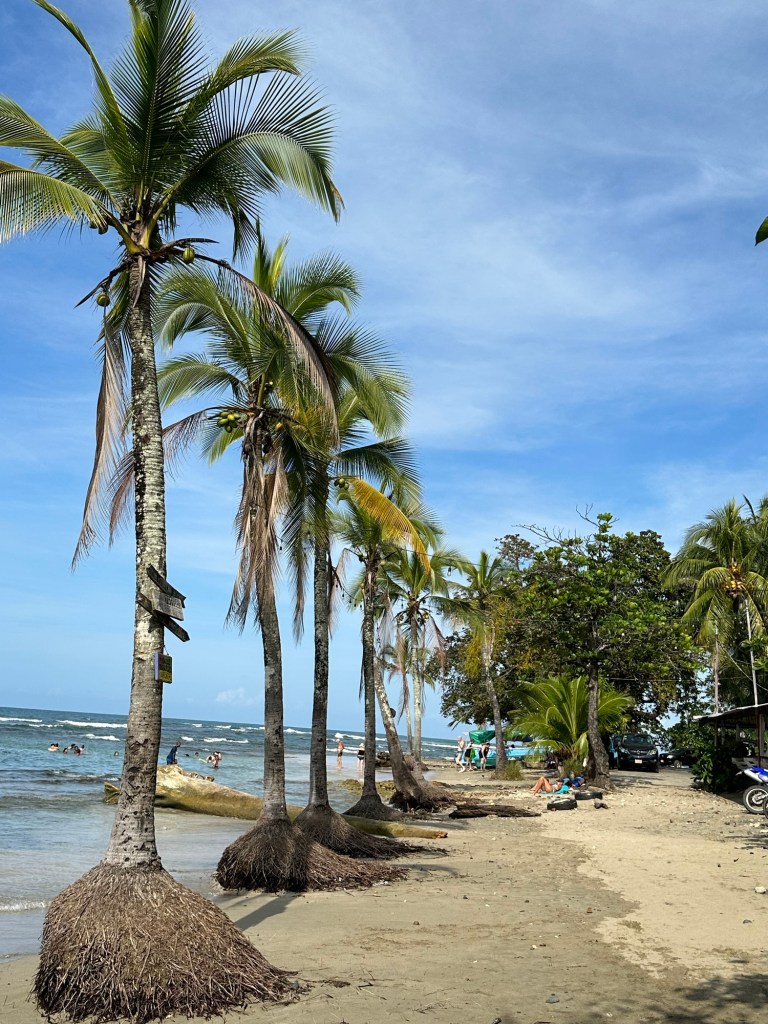
Up nice and early for breakfast after getting my stuff organised to move on. Hostel Playa 506 really is in a beautiful setting. Right out the front of the hostel is the beach. Waves gently crashing is a tranquil soundscape to chill to, but there is much more of this enticing country to experience.
Hostel Playa 506
I got information about where and when to catch the local bus to my next port of call, Cahuita, and waited well beyond the scheduled time. Just as I was about to give up and try hitching with three Aussie travellers I had met at the hostel, it slowly rumbled up. Clearly this bus was on Tico Time! We continued on into and out of Puerto Viajo and up to the tiny town of Cahuita. Lush, verdant countryside passed by as the bus stopped on a regular basis, picking up and dropping off locals. I chatted with the three Aussies who caught the bus with me, swapping travel stories.
Puerto Viajo de Talamanca
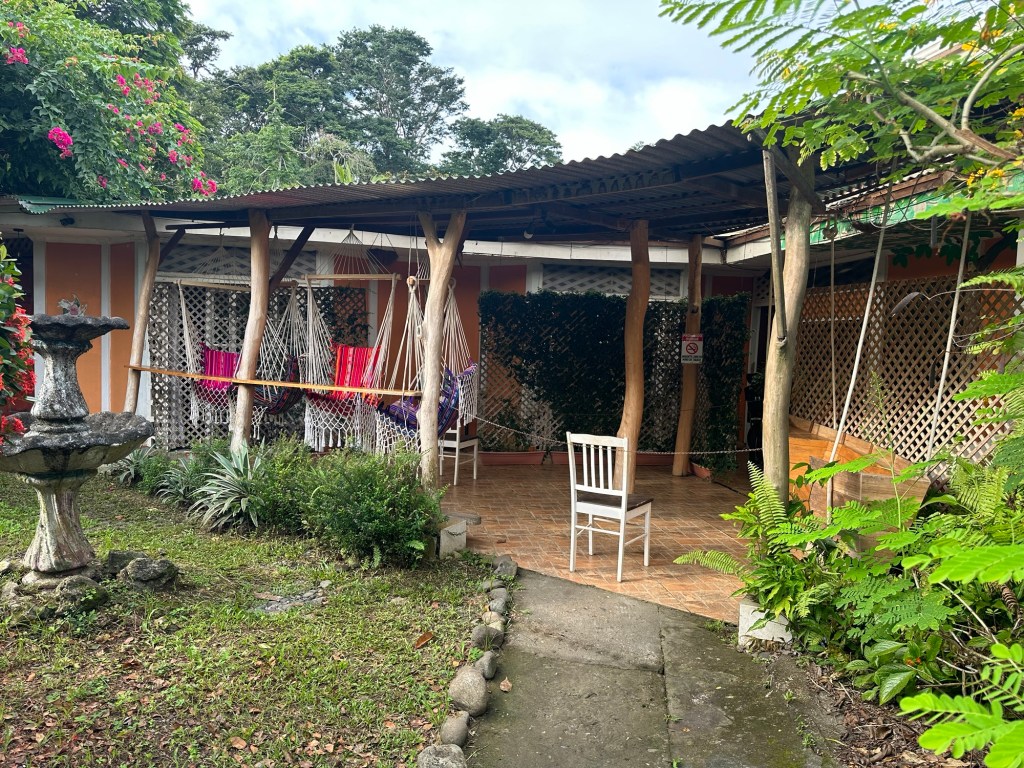
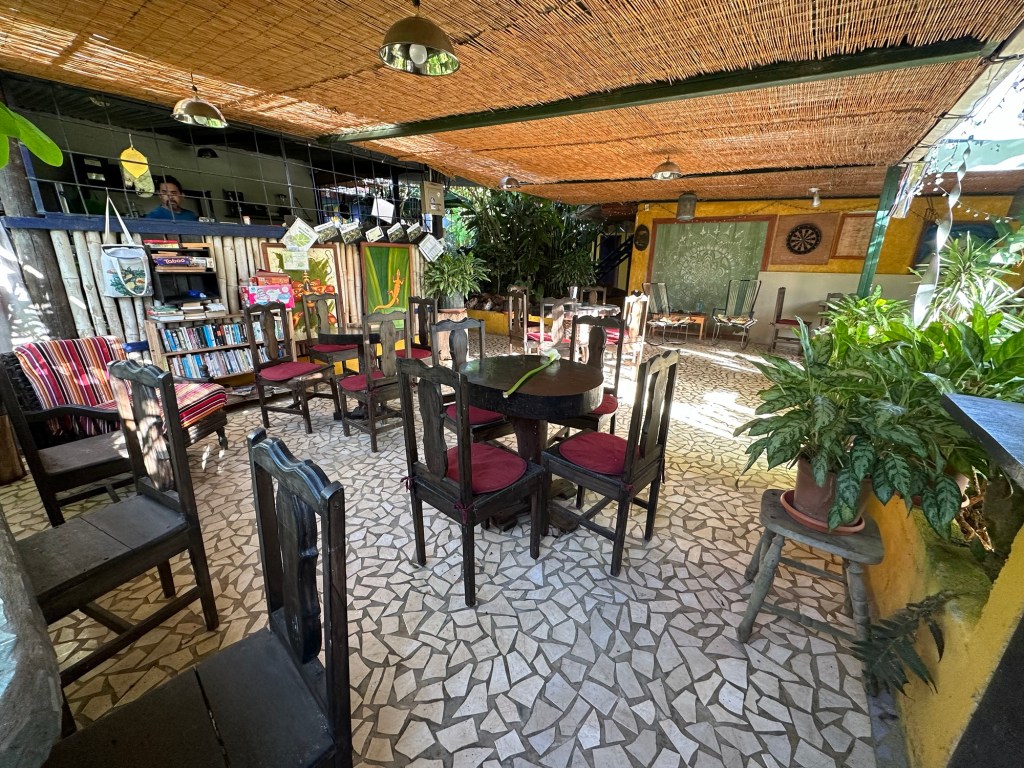
In what seemed no time, we were in Cahuita. I looked where my hostel was and walked the couple of blocks. Secret Garden is a lovely little property located on the edge of the National Park and right in town. It is beautifully appointed and set amongst landscaped gardens. Unfortunately, the dorm room I was staying in wasn’t as salubrious, with five bunk beds crammed side by side with little space in between. Still, each bed had its own little fan, light and charging station so it was all that was really needed.
Secret Garden
I had settled into doing some much needed washing when I got a message from Maria, my Chilean friend. She had moved up to Cahuita the day before and was staying at a nearby hotel. We met up and wandered to the beach at the National Park just up the road for a swim. It just so happened that the hotel at the edge of the National Park had two for one cocktails for AUD10 so I felt compelled to avail myself of a few after our swim.
Playa Blanca, Parque National Cahuita.
It was then back to our respective lodgings where I met up with some other travellers from US, UK, Switzerland and the Netherlands. We chatted for a while before deciding drinking card games were in order and wandered up to one of the local supermarkets to buy beer. There may have been shenanigans and requests to keep the merriment down by management later in the evening, but no-one was kicked out and we eventually called it a night before anyone was. And so endeth my first night in Cahuita.
I went with Maria into Peurto Viajo after breakfast to cash up at the ATM and get some bug spray. I’m trying to use my credit card as much as possible as the ATM fees are astronomical. But some things you have to pay for by cash. There doesn’t seem to be any rhyme or reason behind fees – could just be to do with individual banks, but fees have been as much as 9%. I also needed to get some bug spray. I took a pump pack of Rid from Australia as I couldn’t take an aerosol can on the plane, but it quickly clogged and stopped working despite my best efforts. A massive pity as the aerosol can I replaced it with cost an eye-watering AUD21!! If I end up with any mozzie-born nasties after marinating in this gold-plated elixir, I’m going to be mighty pissed.
Playa Cocles
Back at the hostel, I rented a pushbike for USD7. Given I haven’t cycled outside of the gym for several years, it was a rocky start. But I eventually wobbled my way down the road back towards Puerto Viajo. The bike was very basic with no gears and back brakes but it did the job of getting me along the coast quicker than I could walk. I will hire a motorbike at some stage, but they are quite expensive to rent.
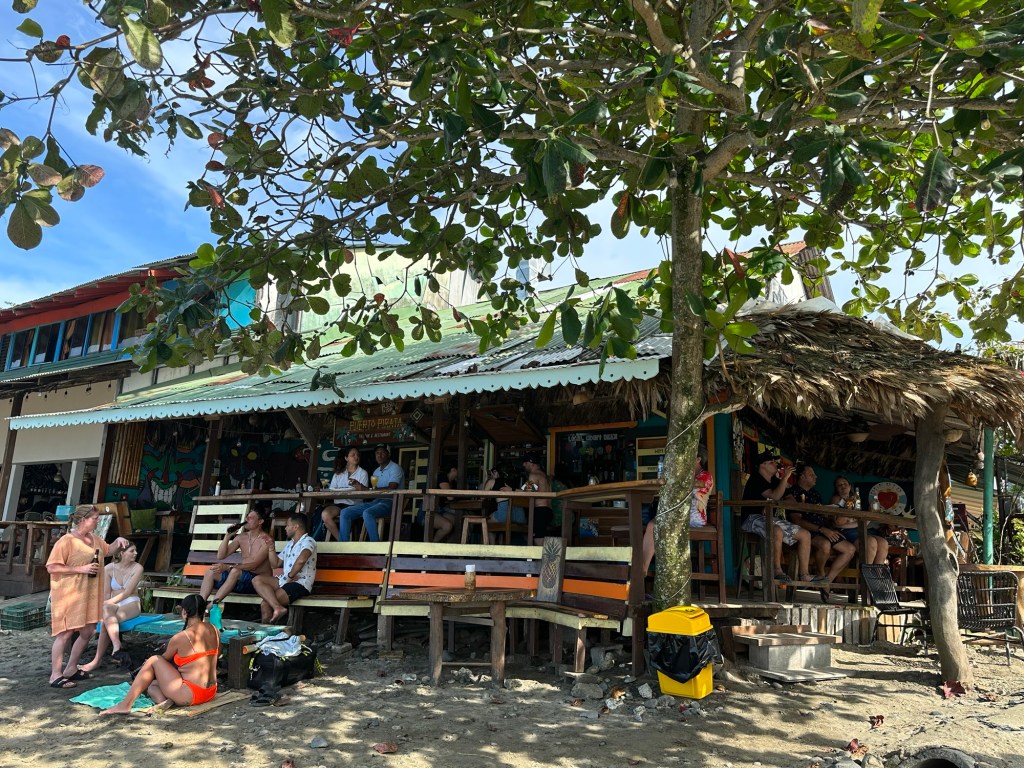
Puerto Pirate
After congratulating myself on riding the three kms back to Puerto Viajo without coming a cropper, I decided to find a beachside bar for lunch and a cerveza. Puerto Pirate certainly ticked that box. With a funky decor and situated right on the beach, it was just the place to partake of tasty honey and lime shrimp tacos and watch the world pass.
Sloth Point, Playa Uva
Suitably refreshed, I jumped back on my deadly treadly (aptly named if you saw my cycling…) and headed back down the coast. I passed my hostel and the Jaguar Refuge Centre and was then in new territory. I wanted to check into the beaches en route and turned into a side street indicating Playa Uva. Riding down a rutted, narrow track, I eventually came to what was signposted as Sloth Point and parked the bike up. Obviously a popular swimming spot, the place was quite crowded so I wandered further up the beach to find a quiet spot to strip off and jump in the surf.
Sloth Point, Playa Uva
On the way back to my bike, I saw a sloth in the trees in the jungle next to the beach. They are such magnificent little creatures. So slow moving due to their extremely low metabolism, it’s like they are doing yoga in the trees and are a joy to watch.
Track alongside Playa Uva
On the bike again and I continued following the coastal track, passing more little beaches until I came to a river. From behind, a guy on a heavy duty beach bike passed me and headed over the river; continuing on the other side. There was no way my little bike was going to repeat those antics, so I pushed it over the hard sand and the narrowest part of the river crossing. Once there, I was able to find a continuation of the track, albeit a very rough, rutted one with tree roots playing havoc with the surface. This is was able to follow until I came to another river. Alas, this one was unpassable.
Mangrove swamp, Playa Uva
Reluctantly, I turned around and followed the track back to the main road. I was hoping to continue on to Manzanilla, however, it was getting late in the day and these roads are not best for night riding. It only took me about an hour to return to the hostel, by which time it was just on dark.
Hmmm. Which way to go??
Bike parked up and it was time for a well earned cocktail in the hostel restaurant. Time also to work out where I was going next. I had decided I would start at the southern Caribbean side of Costa Rica and make my way around the country from that point. Decision made, I booked the next couple of nights on-line in Cahuita and called it a night.
Christmas Day and a lazy start. It’s always a different experience being away from family at Christmas when you’re travelling and everyone deals with it in different ways. Some travellers spend the day glued to the phone to friends and family back home. I personally find it easier to just treat it as a normal day. The time difference between Central America and Australia makes it difficult as well to make connections when you would like.
Hostel Christmas decorations
Maria, my Chilean friend, and I decided we would go out to the Jaguar Rescue Centre to see if it was open as we couldn’t find any information on-line. We caught a tuk-tuk and found it was well and truly open with over 100 tourists booked in for a tour. Fortunately, they split into groups of about 20, each with their own guide, which made for a more manageable experience.
Jaguar Rescue Centre
The Jaguar Rescue Centre is actually a bit of a misnomer. Two European animal biologists met in Puerto de Viajo where one had already moved to. A local brought an injured ‘jaguar’ (actually an ocelot) to them which unfortunately didn’t survive, but that didn’t stop locals bringing the couple injured animals and referring to them as the Jaguar rescue people. The Centre has now grown to a large, well organised organisation running primarily on a volunteer staff, funding from public donations and what they make from tours.
Sansa, the Spider Monkey
Our guide, Carlos, was excellent. He explained how the Centre came about and the threats and challenges facing local wildlife. It would appear that electrocution from overhead powerlines are up there as the main cause of death and injury for animals such as sloths and monkeys. The Centre has an active program raising funds to purchase insulation for the cables to make it safe for wild animals. The Costa Rican power company has agreed to fit any provided insulation as part of an agreement it has with the Centre.
Juvenile Two-Toed Sloth
After our tour, we tried to find a soda (local restaurant) one of the guides recommended, but failed so had lunch elsewhere. Then it was back to the hostel for a chill for the rest of the afternoon. And that was my Costa Rican Christmas.
With the debacle of getting from Cartago to Orosi, I was keen to get accurate information about how to get to my next port of call, Puerto Viajo de Talamanca. It’s quite a long way from Orosi and I knew the journey by local bus would take several hours. So didn’t want to waste time trying to find information on the hop. I had met the lovely Dutch owner of the hostel a couple of nights ago who assured me the bus information in the hostel was correct so decided to rely on that.
Iglesia Colonial de Orosi Convent
I breakfasted again at my little Swiss bakery and while enjoying my coffee, the owner came out with an anxious look on her face. She was concerned that the buses may not be running as regularly due to it being Christmas Eve. I hadn’t considered that as I hadn’t encountered it as being a problem before in Central America. Christmas, Boxing and New Year’s Day, absolutely – most of Central America comes to a stand still. The señorita helping her tried to find information for me and could only find a direct bus from San Jose. Not my preferred option. The hostel owner had put me onto a site called ‘The Bus Schedule’, but I had been having troubles trying to get it to connect. Suddenly, that morning it did and I showed my concerned amigas. As some of the connections seemed a little tight, I decided to leave an hour earlier and leave a bit of wiggle room if I missed any of the connecting services. Thus, I bid adios to the señoras and walked over the road to the bus stop.
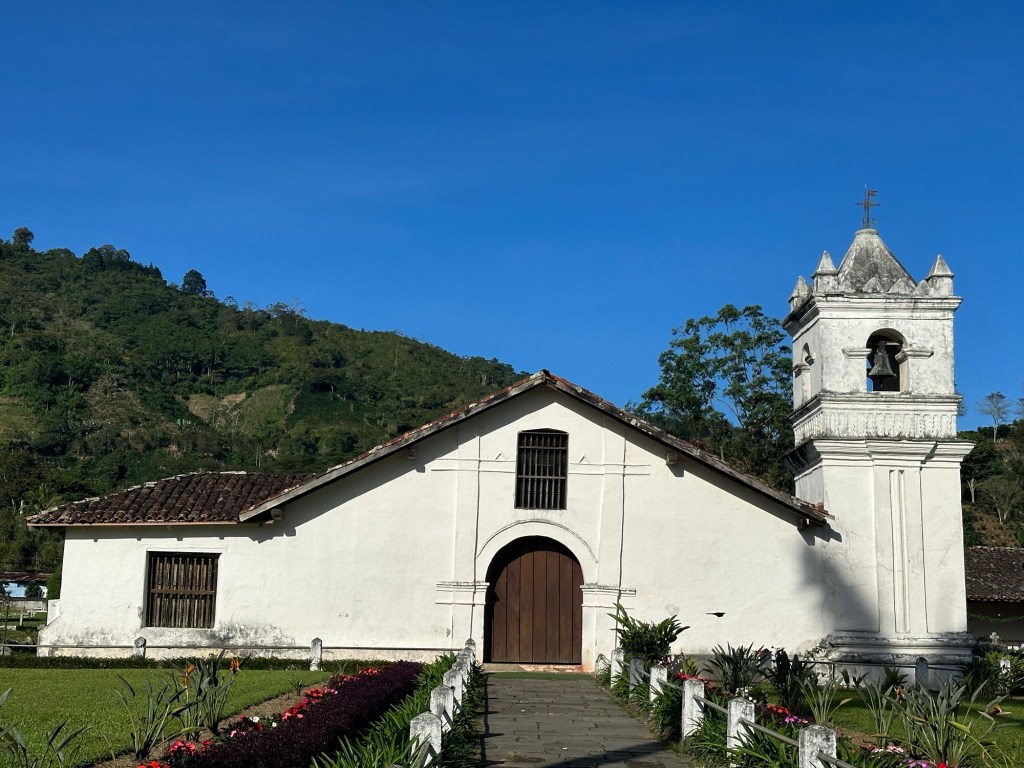
Iglesia Colonial de Orosi
As luck would have it, the 9.30am bus was cancelled, as wasr all subsequent buses for the next 2-3 hours. Vuelta Ciclista a Costa Rica is Costa Rica’s answer to Tour de France and just happened to be passing through Orosi that morning. There would be no buses until it was all over. I went back to the bakery and an amiable hombre filled me in with all the details. I explained I had accommodation booked in Puerto Viajo and really needed to find a way to get there. That was when he offered to take me to Paráiso (the first bus change) after he and his family had had their breakfast as they were going that way themselves. I gratefully accepted and ordered another coffee while waiting.
Local Orosi garden
Pablo and his wife, Jessica, another señora and I piled into the pick up and the three older teenagers jumped on the tray along with my pack and Pablo’s bike. In honour of my being Australian, Pablo decided the appropriate road trip music should be AC/DC’s Highway to Hell. I secretly hoped that wasn’t a foretelling.
Valle de Ososi countryside
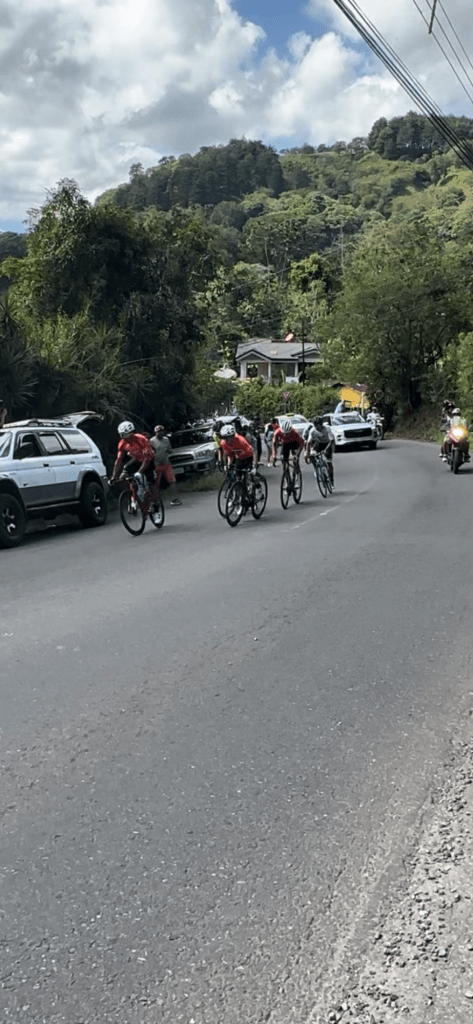
We drove through back roads lined with locals waiting for the race to pass them. And then suddenly stopped on the side of the road on a hill. Pablo explained we were going to watch the race first, then go to the bus station. He kept assuring me that he would get me to the bus on time and not to stress. I had no option anyway as I was a captive audience. The race eventually passed and it was pretty awesome to experience. Especially with locals who could explain what it was all about.
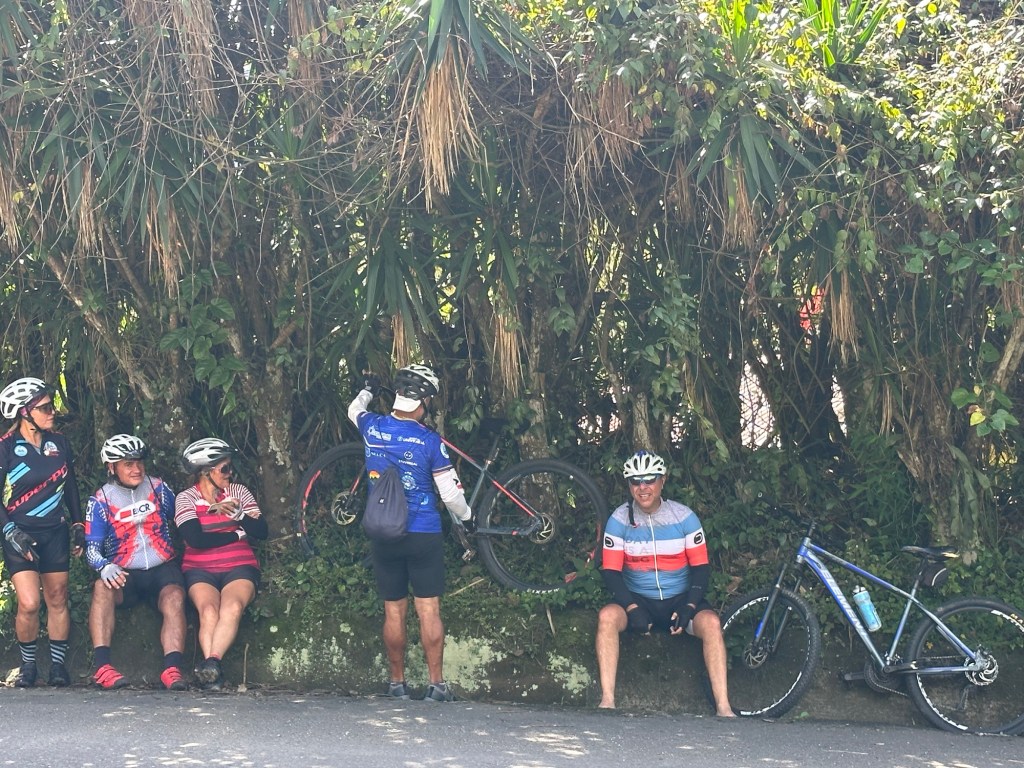
Pablo and other local cyclists
After the last bicycle, support car/van/motorbike, paparazzi, police car/motorbike and ambulance passed, we all piled back in and on Pablo’s pick up and headed off on narrow, windy back roads; even crossing a small stream at one stage. Pablo kept assuring me all was fine with my bus schedule, although, by this stage I was having my doubts. Eventually, we popped out above a large town which I assumed was Paraíso. Alas, it was not. It was Cartago where Pablo and his family lived. Pablo explained we were just stopping at his home so he could get changed and then he would drive me to the bus station. I was desperately trying to get The Bus Schedule site to connect as we were now way past any bus timetable I had already searched.
Vuelta Ciclista a Costa Rica
Pablo cheerfully dismissed my concerns and we jumped back into his pick up to drive to the local bus station. He asked the señora there about connecting buses down to Puerto Viajo but wasn’t satisfied with the answer. Pablo thought it a safer option to go back to San Jose and take a direct bus. By this stage I was starting to think the same. I thought he was driving me to the bus station to take a bus to San Jose, but he drove me directly there himself instead – about a two hour return trip! He checked everything was in order before leaving me there. I was so grateful for his kindness. I tried to give him some money for fuel, but he wouldn’t accept it. Pablo explained he had travelled extensively and that other people had helped him out, so he was happy to help out a fellow traveller.
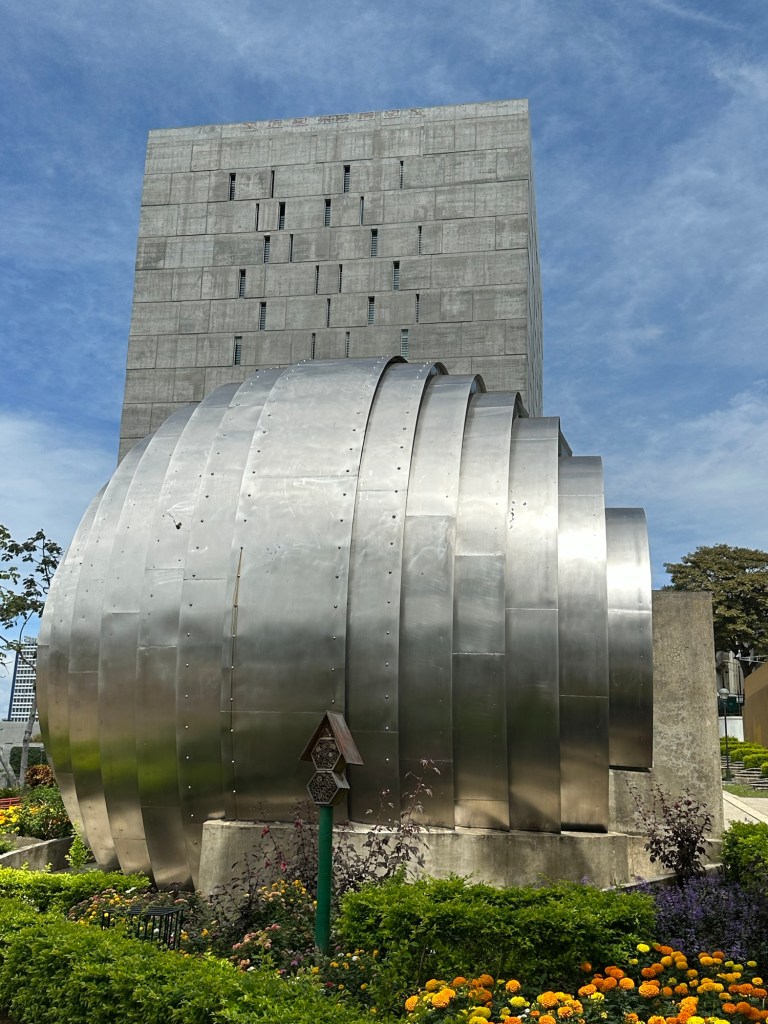
San Jose sculpture
At 2pm, my bus rumbled out of San Jose and began its long, uneventful journey down to the southern edge of Costa Rica’s Caribbean coast. I eventually rolled into Puerto Viajo de Talamanca around 6.30pm. I caught a taxi with two other backpackers staying at the same hostel, checked in and found my Chilean friend, Maria. It turned out some of the backpackers had organised a Christmas party and invited us to join them. Festivities ended with a bonfire on the beach and a late night.
Determined to get out and see more today, I was up early and out the door by 8am. I went back to my favourite little Swiss bakery for breakfast and to set a plan for the day over a couple of cups of tasty coffee.
Iglesia Colonial de Orosi
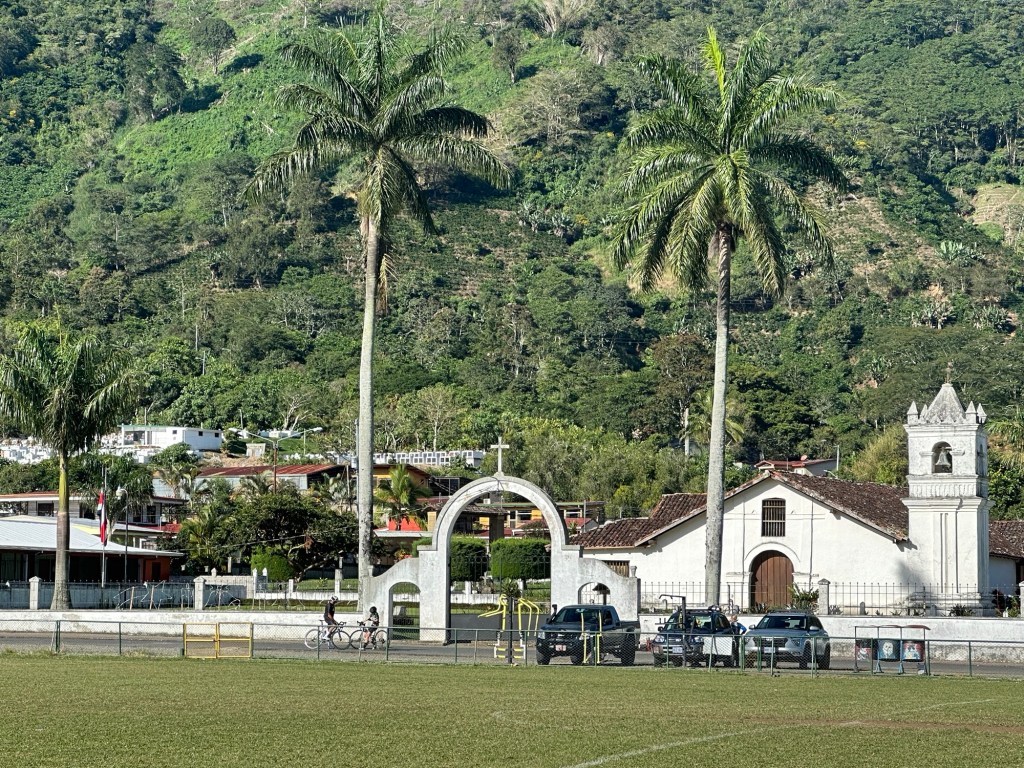
The main church in Orosi is the longest continually operating church in Costa Rica despite being only 250 years old. It is a sweet little building with a lot less of the ostentatious trimmings found in most Central American churches. There was a wedding taking place when I got there so I had to wait to poke around until afterwards. Fortunately, there was a very interesting little museum in the old convent wing attached to the main church. Some fascinating historical ecclesiastical items fished out of local Catholic institution storerooms made up the majority of the display.
Museo de Iglesia Colonial de Orosi
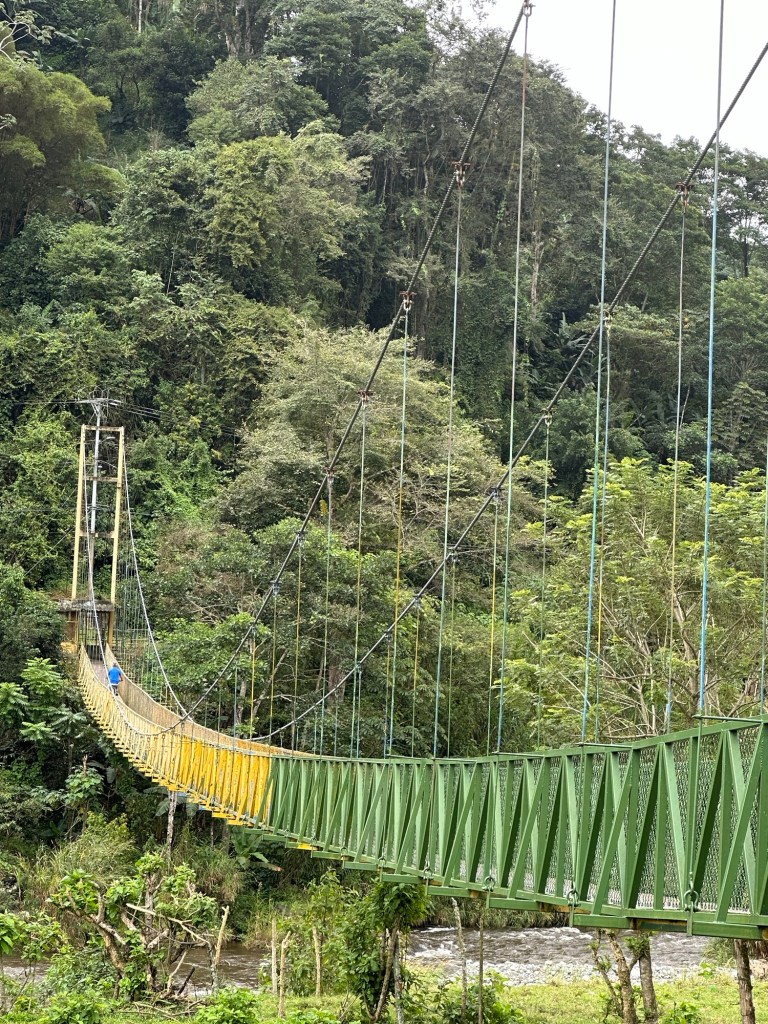
Heading out of town, I crossed the Rio Grande de Orosi on what is known as the Puente de Hamaca de la Alegría, or the Happy Hammock Bridge. This pedestrian suspension bridge connects people living on the other side of the river with the main town and provides a novel way of crossing the river. Plus, it provides a much safer way of taking happy snaps of the river without worrying about an errant vehicle not so gently nudging you into its depths.
Puente de Hamaca de la Alegría
I noticed on the map, there was a lake only a couple of kilometres away that I thought I would wander out to. Unfortunately, I discovered the land around this closest point to me was privately owned and to go down to the lake’s edge, I would need to walk another few kilometres. As I had already come this far, I decided to continue. The road was narrow and not much in the way of easement on the side in most places, but the traffic was reasonably infrequent so I was able to work around it with a degree of safety.
Lago de Cachi
Eventually, I came to a rutted, muddy track that lead down to the lake. Lago de Cachi is actually a reservoir and hydroelectric power-plant the Costa Rican government built in response to the devastating floods that used to plague the area. Now, it is a impressive, picturesque body of water, fringed with massive clumps of water hyacinths.
Lago de Cachi
As the town of Cachi was only another couple of kilometres further on, I decided to walk there and see about the possibility of catching a bus back as it was now on dusk and I didn’t fancy dodging speeding vehicles on a dark, narrow, windy road. I got information about buses from a couples of señoras who advised I would need to go into Cartago and then back out to Orosi. Although not ideal, it was the safer option. I was directed to where the Cartago bus would stop and at the appointed time, it lumbered up.
Cloud cover over hills above Cachi
The thing about Costa Ricans is that they smell great. Like a waft of sweetly scented fresh laundry. Unfortunately, after traipsing some 7kms in the humid countryside, I did not. And was most mindful of that as I climbed aboard the tightly packed bus. Still, it couldn’t be helped. We drove over the dam wall and although it was nearly dark by this stage, you could still make out an impressive drop into the valley below. The bus lumbered on through the hilly terrain and on into Cartago. This time I had the secret information about where the bus left from, though, I needn’t have worried. The bus pulled up directly in front of the Orosi bus. A few minutes later, I was back on the road again and this time got off in town. A big day, but most enjoyable. It’s great to be out in the countryside and poking around its fringes.
Yesterday took it out of me so I rested up until midday and took the opportunity to do a bit of washing. I’m the only one staying in my six bed dorm so really have the room to myself. Which was just as well seeing as I strung a week’s worth of washing across it.
Montaña Linda Hostel
I went out in the early afternoon to source food and found a delightful little bakery run by a Swiss lady who had been in the valley for the past 30 years. La señora wasn’t surprised to learn there were very few people staying at the hostel. She said that since the country had become so popular with tourists from Canada and the US, prices have been driven sky high which is having a knock on effect to places traditionally popular with travellers who now prefer to take their carefully coffered coins to more affordable neighbouring countries.
Surrounding hills
Refuelled, I went for a stroll around this pretty little town. Orosi is neatly nestled in a verdant valley, through which the Rio Grande de Orosi flows. The town itself is spotlessly clean and little casas with immaculately tended gardens and terraces front it’s streets. Nearly every casa has a pampered pooch or three and many a well-dressed, well-behaved hound can be seen being lead around the streets by its proud owner. The people are very friendly, greeting everyone they pass with a smile. There is much to like in this little community.
Hills behind Iglesia Colonial de Orosi
Dusk fell early, as it does in this country, so I returned to the hostel for a quiet night.
I had a much better night’s sleep and was up when the alarm went off at 6am. Caffeinated into a false sense of wellness, I checked out of my hostel and walked the few blocks to the train station.
Estación Atlántica
Estación Atlántica is the main train station in San Jose that links to other towns and cities in the Highlands of the Central Valley. It is a gorgeous Colonial era building with many of its original details still intact. Through to the actual platforms, is another story, though. Functional steel ramps and stairways lead to awaiting spotlessly clean, modern carriages. Which then traverse over rickety, old line. None of the parts seem to match but somehow it all works.
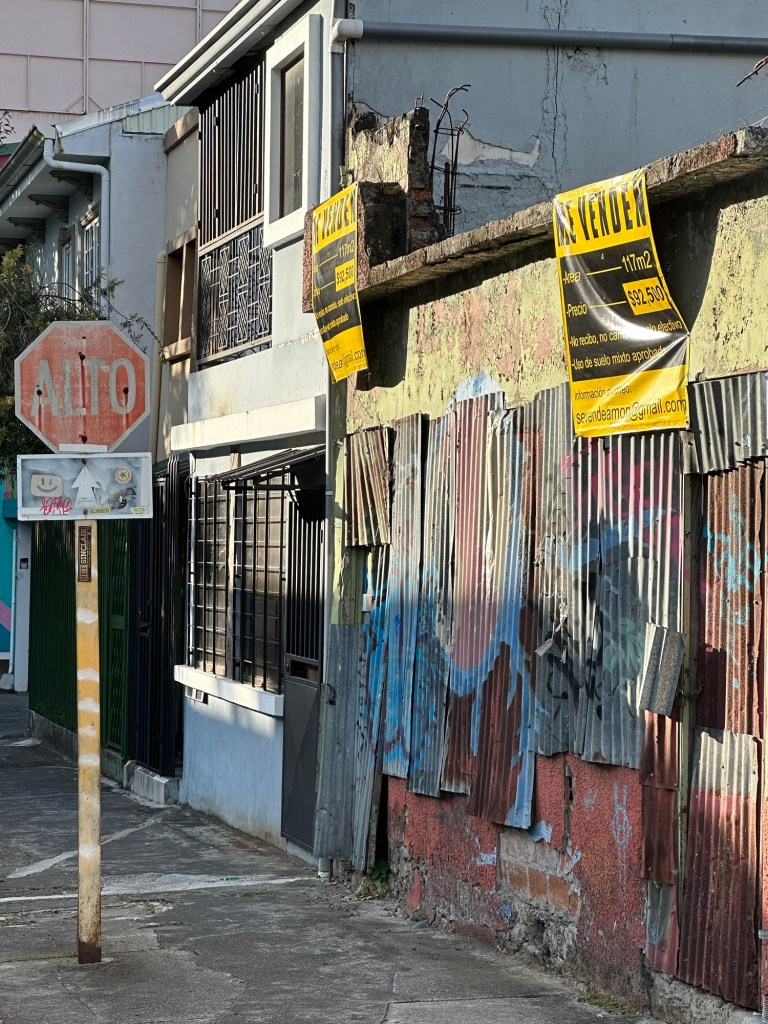
Not everything gleams in San José
Upon arrival in Cartago, I went to grab a coffee and something to eat. Which I then took back to the train station platform to have finding nowhere else to sit. That was until I was booted out by a transport officer who advised that the station was now closed and I would have to move on. I walked a few blocks until I found the main plaza, Plaza Mayor. There, I could finally get my bearings.
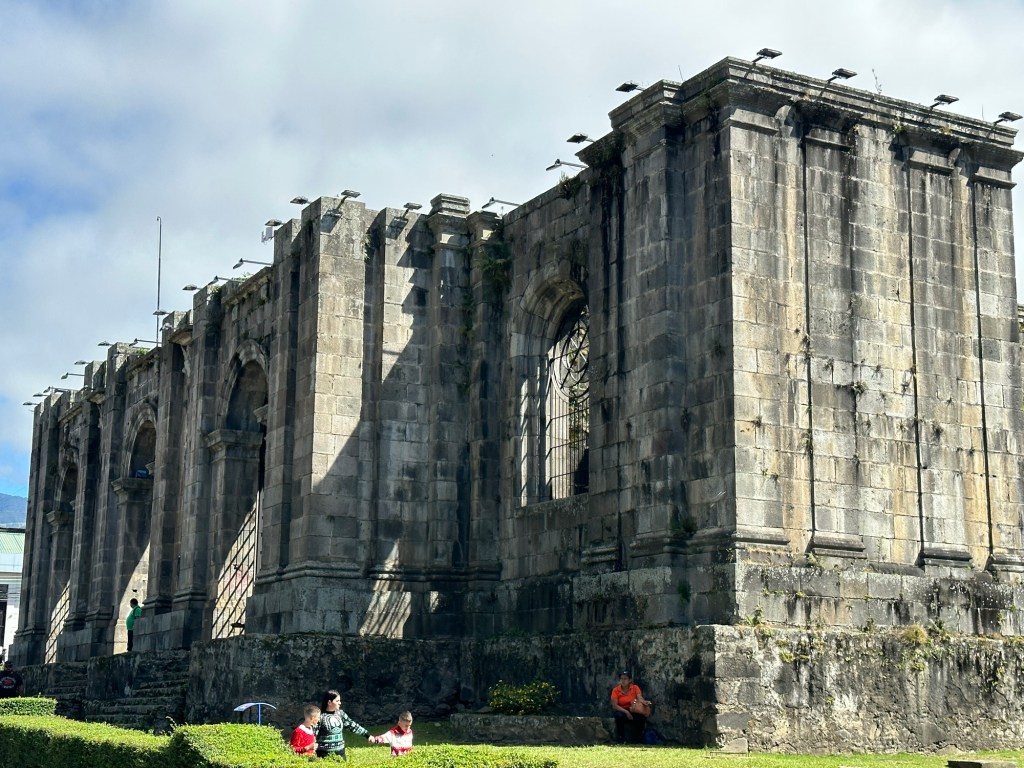
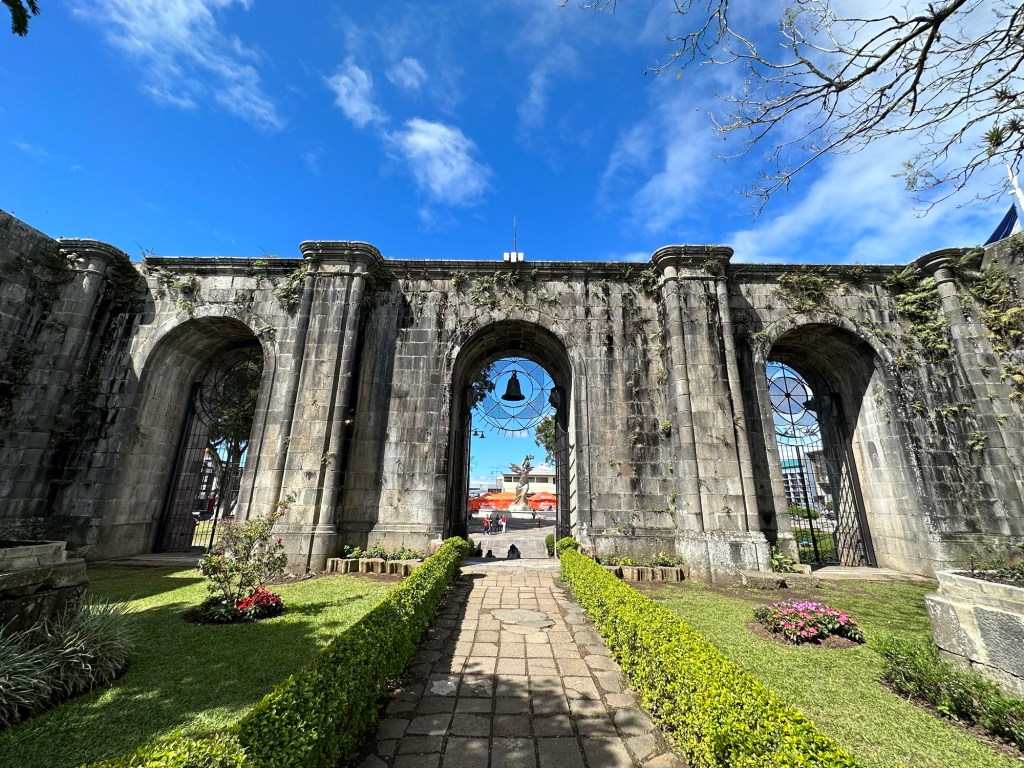
Las Ruinas de la Parroquia
Las Ruinas de la Parroquia lie on one side of Plaza Mayor providing an impressive, albeit somewhat surreal, bookmark. This imposing facade is all that is left of a once magnificent church dating back to the early 17th century. Evidently, the original church was destroyed by an earthquake in 1630. No worries, said the good folk of Cartago, we’ll just rebuild. That was before Mother Nature decided to string together a series of earthquakes over the next 220 years which thwarted progress on the rebuild. Finally, the Cartago folk agreed it just wasn’t worth the effort and left it be. The result today is a beautifully landscaped interior, resplendent with an ornamental pond the kids can throw their hard earned pocket money in. Plus, there’s a really cool ghost story about a headless priest that roams the ruins on foggy nights. Clearly, this is a feature that ticks all the boxes.
Las Ruinas de la Parroquia
My next stop was to visit a church with a different back story. Back in 1635 (or so the story goes), a woman found a statuette of the Virgin Mary holding baby Jesus and decided to take it home. For some inexplicable reason, the statuette kept disappearing from her house and ending back where she first found it. It turns out that when the lady spread word of this incredible turn of events, the good folk of Cartago were very interested indeed. It seemed that they had been trying to build a church for some time, but those pesky earthquakes that are a feature of this region kept hampering efforts. What if, this was a sign from the Good Lord to build the church where the statuette was found? Regardless, this building stuck and has been in situ ever since, despite numerous rebuilds over the centuries. And the statuette which was the result of all this takes pride of place at the alter.
Basílica de Nuestra Señora de los Ángeles
Unfortunately, when I got to the Basilica, a service was about to start so I decided to visit another place on my list and come back when the service finished. The Museo de Cartago is actually a gallery space but I was interested in checking out the building it is housed in. Built at the turn of last century, it was originally an army headquarters used by officers in command. Like anything to do with the old army, it has been recommissioned for more peaceful purposes. Although it was pretty much a shell of a building, the cells were still available to see, as was a stone staircase that lead from that part of the building to an upper level.
Museo Municipal de Cartago
Back to the Basilica and as the service was just finishing up. I took a seat and an opportunity to have a brief play with my blog site settings as they had all changed since I last used it. Suddenly, I had unwitting changed themes and couldn’t reverse it. My site was a mess, my ‘About’ page had disappeared and I couldn’t work out how to fix it on my mobile. I don’t know if the hand of God was on me at that moment but if it was, he was in a mischievous, meddling mood. I decided to shelve it for a bit and have a look around the Basilica.
Basílica de Nuestra Señora de los Ángeles
I decided I would make my way to my final destination for the day, Orosi, where I had a hostel booked. Unfortunately, Lonely Planet in its infinite wisdom has decided to rip out all the useful information it was originally designed to provide and leave a shell of a guidebook which mainly deals with what to see. I did find an on-line bus schedule for Costa Rica which was brilliant, however, it didn’t give you any information on where the bus left from. I searched on-line and found a bus station so walked to where that was. A somewhat disinterested bus driver grumpily told me the bus I was looking for didn’t leave from that terminal and gave me directions on where to go. I followed his directions to find nothing, so went into a shop and asked someone else. This hombre wasn’t sure but directed me along a road where ‘he was pretty sure there was another bus station’. I duly followed until I was fairly convinced I was on another bum steer so turned around at the next intersection.
Downtown Cartago
By now, I was hot, sick and grumpy and the execs of Lonely Planet were being soundly cursed. I had very little voice so asking anymore wasn’t really a viable option. I searched again on-line and found a mention of a corner the bus to Orosi left from so walked to there. However, no Orosi bound buses were to be found. I had the route number from the bus schedule site so showed one of the ‘somewhere else’ bound drivers who gave me directions to the Plaza Mayor. I followed, but yet again, no Orosi bound buses. As I got to the end of the Ruins, I spotted a bus with Orosi displayed and gratefully made my way over to it. The door was shut but the driver opened it to explain that I needed to go somewhere else to catch it. I could feel tears prickling as my new found hope dwindled yet again. Dubiously, I followed these new set of instructions and arrived at the destination, nose running, windswept hair strewn across my face and hacking up a lung. I had definitely had put the ‘wild’ into ‘wild woman’! Fortunately, there was my chariot awaiting to cease my misery and carry me onwards. I climbed aboard.
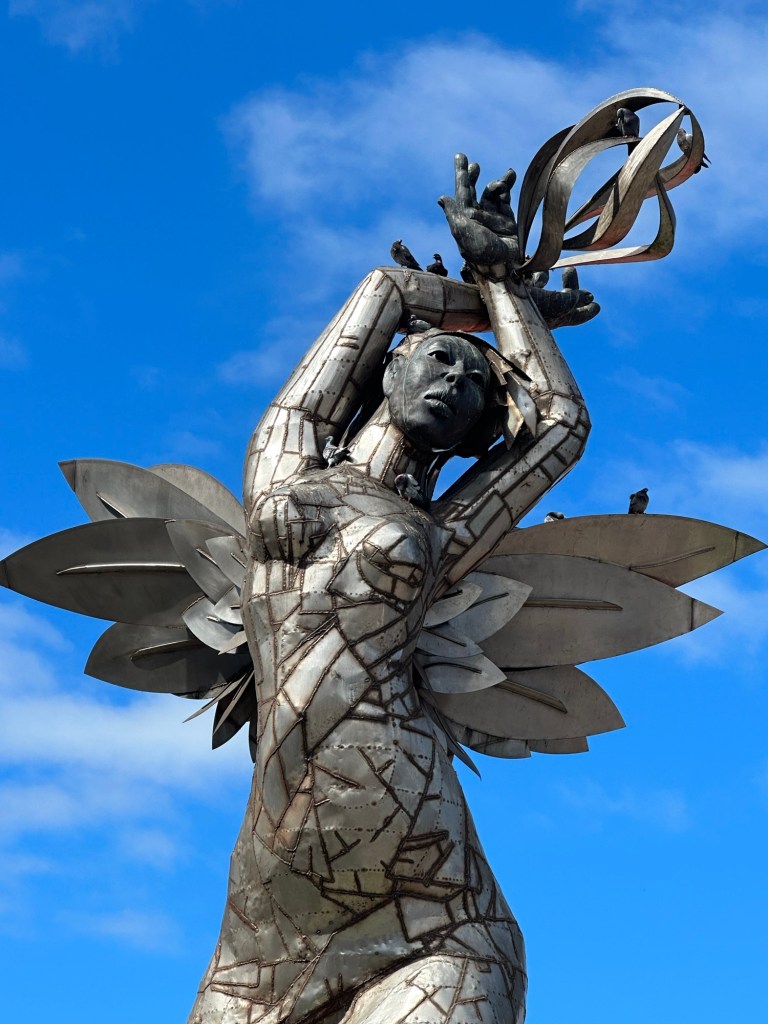
Costa Rica Victoriosa, Cartago
Now you would think it would be plain sailing from here to get to my hostel, but I was paying penance for playing on my phone in church. The bus had Orosi emblazoned across it’s screen, which I took to mean it terminated in Orosi. Apparently, that is not necessarily the case in Costa Rica. By now it was on dusk and I was enjoying the scenery from my seat when I jolted to my senses. A sign to Orosi pointing in the direction from whence we had just come. I grabbed my phone and checked. Yep, Orosi was on the wrong side of our ongoing direction. I told the driver who somewhat unceremoniously dumped me on the side of the road with a vague wave of his hand to indicate I should wait for a bus going in the other direction. I decided I would start to walk back rather than just wait. After a while, I checked how far back Orosi was and decided I would just walk it all the way. Fortunately, there wasn’t a lot of uphill so my poor lungs coped, but it was well and truly dark by the time I finished the 5.5kms to the hostel. I checked in and went across the road to a little pizzeria for something to eat, then a well deserved rest.
Another bad night saw me shivering uncontrollably with fever so decided to sleep in until midday again. Had coffee at the hostel before heading out to wander a bit in another barrio of San José.
Blooming marvellous
Barrio Escalante is a neighbouring barrio to Barrio California where I was staying so I didn’t need to wander too far. It would seem that this barrio is for the well heeled; although anyone trying to traverse it a la Carrie Bradshaw would probably want to rethink that considering the state of the pavement… I was far from well, but couldn’t just stay at the hostel. I knew I needed to get something to eat to take my magic meds with, so wandered out to find somewhere reasonably priced.
Street Mural
I thought I would be able to find a soda, which is where the locals eat and are fairly cheap, however, it would appear that Barrio Escalante snubbed its nose at that and the only places I could find were upmarket bars and restaurants. Undefeated, I spluttered my way along the main drag until I found a cozy, little, not too overpriced offering where I gratefully slumped into a chair. The frijol empañando was tasty and hit the spot.
Museo Calderon Guardia
Afterwards, I walked the few blocks over to the Museo Calderon Guardia. Dr. Rafael Calderon Garcia was president of Costa Rica 1940-1944 and is credited with implementing many of the social reforms which form the basis of modern day Costa Rica. Despite his absolute humanitarian bent, the Calderon Garcia’s were not short a colones or two as the museum is located in the former family home/mansion. Though to be fair, to further oneself (or even get an education in those days) was restricted to the wealthy and society elite. Calderon Garcia looked to changing that and implemented far reaching reforms to better the lives of all Costa Ricans.
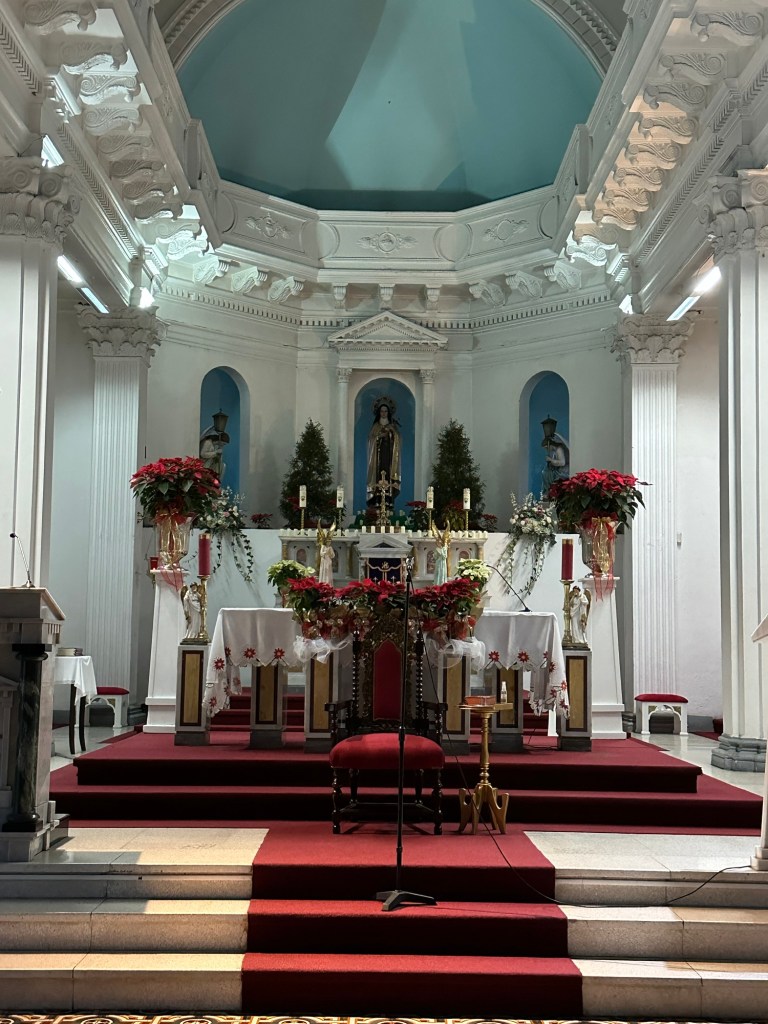
Iglesia Santa Teresita
My next stop was a quick peek inside Iglesia Santa Teresita. This sweet little church, with its duck egg blue and crisp white interior, is fairly well a newcomer to the Barrio Escalante streets. Built in 1941, it’s design would suggest a much older building. Nonetheless, it’s an enchanting addition to the local streetscape.
Iglesia Santa Teresita
By this stage, the sun had well and truly set and I was well and truly done for the day. Last stop was to check the timetable for the following day’s train and back to the hostel with my 1L bottle of beer. Well, one does have to keep hydrated in times like these.
Alarm went off at 6am and I was up ready to make the most of the day. I had had a better night’s sleep, though still feverish at times. I wasn’t confident my little bottle of elixir was doing much so wanted to try find something else. After a pretty average breakfast, I headed out to source different pharmaceuticals and see some sights.
Parque Morazan
I found another pharmacy downtown which looked a bit more the part than my previous experience and was greeted by an hombre in a white medical jacket. Good start. He even asked the right sort of questions, so I put my faith in his ability to sort me out. I showed him my little bottle of elixir and he confirmed what I had already worked out – it was only for the cough. An array of pharmaceuticals were produced and I managed to get it down to three different tablets which evidently all did something different. Where were Codral Night and Days when you needed them! In Costa Rica, you don’t buy whole packets of tablets, you pay by the pill. I decided to go with three days worth which cost me an eye-watering AUD30. When I think about doing Costa Rica on $10 a day, I wasn’t thinking about that being the cost of my medications!!
Parque Morazan
I went to a little cafeteria above one of the more upmarket supermarkets for coffee and something to eat so I could start my course of wallet-draining substances. While I was there, I took the opportunity to check out the prices of some things I would need to replace eventually during my stay here. I needed something stronger than coffee to get my head around some of the prices: AUD8.50 for the same brand of deodorant I use back home with the local offering not much cheaper. At least the beer was reasonably priced. Silver linings…
Teatro Nacional
The two places I wanted to check out were close by, so I took a stroll through the throng to find the Teatro Nacional. This amazing theatre was built in 1897 and features all the European architectural features that were the rage of the day. Not a place to see with a hangover, as the gilt and ornate trimmings really are quite over the top. Still, it is very impressive. I took a tour with an enthusiastic señorita who effused about the many and varied aspects of the theatre. My favourite was the very expensively commissioned main painting on the ceiling in the main foyer which was painted by an Italian artist who clearly had never been to Costa Rica. Nor seen a banana. The artwork was to depict a local scene representing daily life of Costa Ricans. El Señor had coffee plantains alongside the beach and depicted an hombre carrying a bunch of bananas upside down. Wonder if his cheque cleared.
Gilt, gilt, gilt
The second place I wanted to visit was right next door and situated in a very modern, high tech building. The Museo del Oro Precolombino is owned and curated by the Banco Central de Costa Rica. It’s actually an underground museum with the entrance below street level under the Plaza de la Cultura. You go down a wide, sweeping staircase to a gallery space, then further down to the Museo del Ora Precolombino. The collection features some pretty spectacular pieces and interpretation panels in Spanish and English give insight as to how they were used in pre-Colombian times. Back up at entrance level was an interesting exhibition on the development of Costa Rican currency.
Sculpture outside Iglesia Nuestra Señora de la Merced
I headed back to the hostel afterwards as I was starting to run out of steam. I’m hoping my super expensive meds will start to kick in so I can get over this lurgy sooner rather than later.
Wee hours of the morning saw me shivering with fever and feeling pretty damn shit. I sought out extra linen and another blanket, then spent a fairly uncomfortable night trying not to throw up. Ignored alarm in the morning and dozed on and off until midday. By then, I forced myself to get up, shower and go out to source pharmaceuticals to get me through the day.
Edificio de Correas
Looking on Maps.Me, it looked like there were a couple of pharmacies only a few blocks away so I headed in that general direction. After finding neither, I resorted to asking locals with little success. Eventually, I had it confirmed that I would need to go back into the city centre for what I was after. Zombie like, I negotiated San José’s hectic traffic and succeeded in not becoming roadkill en route. I stumbled upon the local train station I would need when moving on out of here so one objective was met.
Railway crossing San José
First pharmacy I came to, I stopped and tried in halting Spanish to explain what I needed. Words in any language were becoming challenging, however, the hombre behind the counter spoke reasonable English so I reverted to that to make life easier. He presented me with a little bottle of elixir which I was quite dubious about, but assured me it would do the trick.
Parque Nacional
After throwing some of the mixture down my throat, I decided I would walk around a bit before going back to the hostel. San José is definitely a very walkable city so long as you are aware of what the traffic is doing at intersections. I always find watching how the locals engage with the traffic is your best gauge on how to go about it.
Parque Nacional
Back at the hostel, I finally collapsed and decided an early night was in order.




















 Wild Woman Wandering