Dominical – Uvita

I slept like a baby listening to the waves crashing on the beach over the road from the hostel so woke fresh to start the new day. This little hostel harks back to days when travel was more basic. No doors, only curtains. Open air living spaces. Sand everywhere. And the most basis of basic of amenities. Its reto charm was what made it. Plus it’s hippy, surfer Italian ex-pat owner who was more about collective positive energy than collecting colones.

View from hostel deck, Dominical

It would have been nice to spend a bit more time in drowsy Dominical, but I had a bus to catch. After checking out the beach, I found where the bus left from, then wandered down the beachfront road to grab a coffee to take with me.

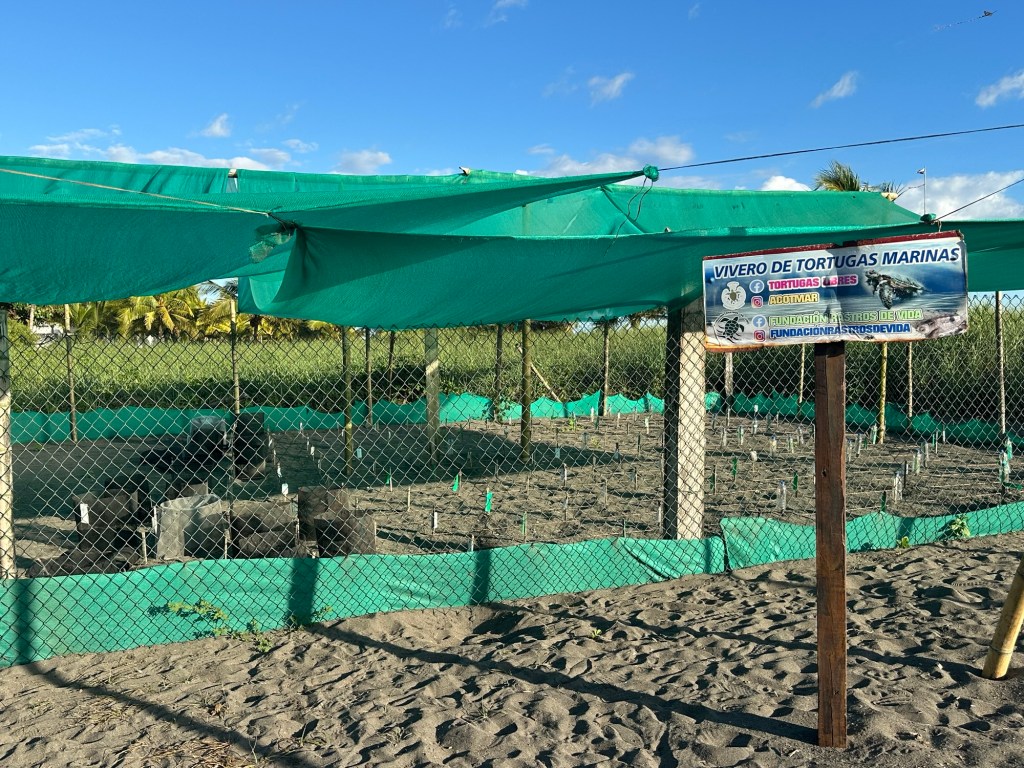
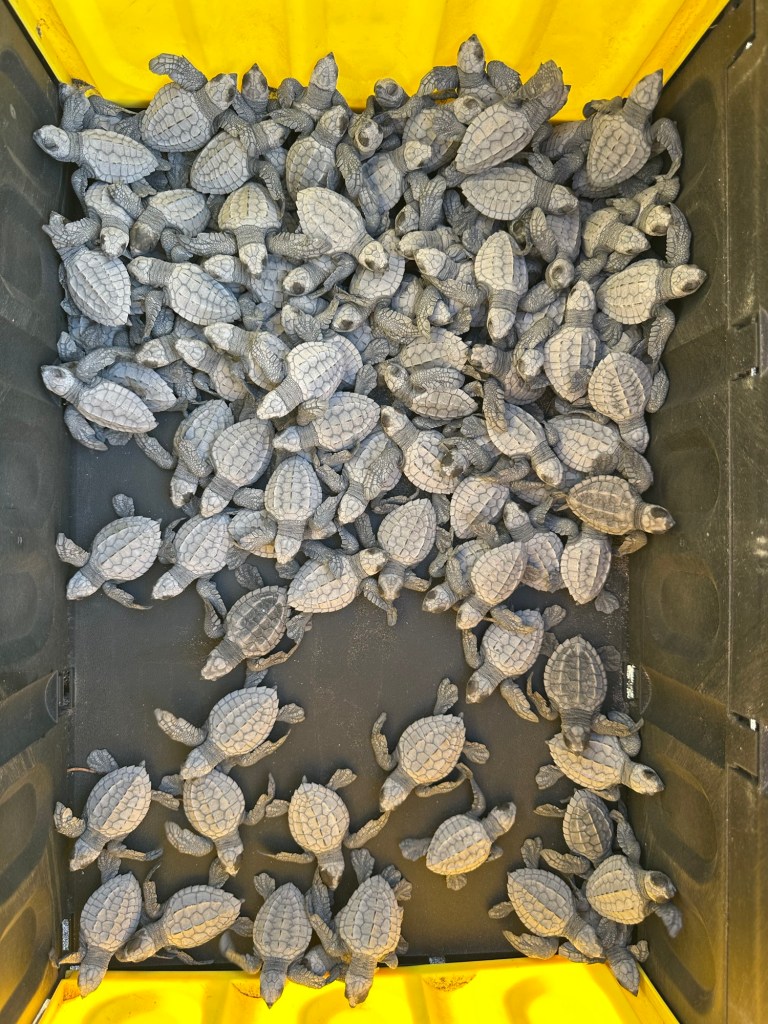
Turtle conservation sculpture, Dominical

As I was first in the bus, I had prime position in front to take in the views. And they were worth taking in. The road hugged the coastline pretty much the whole way to Uvita, affording numerous glimpses of turquoise water gently crashing on cinnamon-hued beaches. All surrounded by verdant jungle. I knew I would probably have to walk from where the bus dropped me off to my hostel, but it ended up being much further than I anticipated in the searing midday sun. So I was well and truly happy when I reached my destination.

Luminosa Uvita Hostel, Uvita

I couldn’t check in until 2pm so left my pack at reception and walked to the national park at the end of the road. Parque Nacional Marino Ballena is primarily a marine reserve which takes in adjoining beaches and their abutting mangrove forests. Its most famous drawcard is the ‘Whale’s Tail’ – a rocky headland connected to a tidal sandbar which when exposed, looks remarkably like a whale tail from above. As an added bonus, migrating humpback whales regularly promenade these shores twice a year in season. It’s as if the ‘Whale’s Tail’ is on their bucket list as well.

Entrance, Parque Nacional Marino Ballena

I started walking on the beach as I couldn’t find the trailhead for the jungle trail which ran alongside. After reaching the ‘Whale’s Tail’, I found the observation deck which was also an entry point to the trail. The tide hadn’t fully gone out at this stage, so the waves were meeting and crashing in the middle of the sandbar. Now I had found the trail, I followed it for it’s northern duration up to the Rio Uvita. This route was much cooler; shaded by a dense canopy as it wound its way through the jungle. All the time, the crashing of the waves could be clearly heard through the foliage.

Rio Uvita inlet, Uvita

I popped out at Rio Uvita where an hombre was fishing with his son. It was a picturesque lagoon and I dearly wanted to take a dip, however, the señor was most adamant it wasn’t safe due to the presence of crocodiles. I had to settle for a swim in the rip-prone sea instead which prevented me from going too far in. Still it was refreshing and prepared me for the walk back along the beach.

‘Whale’s Tail’, Punta Uvita

By the time I returned to the ‘Whale’s Tail, the tide was at its lowest and the sandbar was fully exposed. I walked its length to the little rocky headland so I could take some photos. It was certainly pretty with the jungle-clad hills in the background and the little rockpools which had formed on the headland.

‘Whale’s Tail’, Punta Uvita

Now I knew where the trail was, I took the southern route back out. This trail passed a little lagoon, fringed with drooping vegetation. As this was prime croc country, I quickly took my photo and moved on. It was a pretty little trail which wound its way through the jungle to spit its venturers back out on the beach further down. It was then a matter of following the beach and finally a dirt track back to the entrance.

Lagoon, Parque Nacional Marino Ballena

By now I was well and truly ready for a soothing cerveza. I found a little restaurant for a beer and something to eat while waiting for the temperature to drop a little before walking back to my hostel in the gathering dusk.

Jaco – Dominical

Jaco salvaged itself slightly with the view over the top of its disauthentic drama to the mountains from my elevated hostel deck. Breakfast started at 8am and I estimated the bus I needed out of there came through around 9.30am so plenty of time. All organised and with a renewed attitude, I was dismayed to find I had miscalculated the bus arrival by an hour as the 8.30am bus zoomed past 45 minutes late. I now had an hour to wait for the next scheduled bus and that was if it too wasn’t late. I was peeved.

View from hostel, Jaco

As I had the time, I thought I may as well check out the beach. Whilst the jungle clad headlands were pretty, this particular playa had nothing to recommend itself. Crowded and adorned with miscellaneous beach accessory rentals, the beach itself had debris-strewn, dark brown sand. I know it’s hard to impress an Aussie with a beach, but there are truly much more beautiful ones in Costa Rica. And without the shadow of looming high-rise condominium towers. I left the beach and found somewhere to get a fruit smoothie while I waited for the bus. I would have loved to have been able to get one beachside, but that remains the property of swanky hotels with swanky prices to match. Not for this wild woman.

A quieter part of Playa Jaco, Jaco

As luck would have it, my bus was nearly an hour late, so my departure out of Jaco was significantly delayed. As we rumbled through the main drag and up the hills on the other side, I did see a quieter, more pretty side to jostling Jaco but not enough to encourage a recommendation. It was a different story further on as the road hugged the coastline in places and wound its way through pretty hills in others. The breeze from the open windows and the quiet chatter of passengers lolled one into a pleasant state of peacefulness.

Quepos

The bus lumbered into the bustling little town of Quepos, which is the launching pad for Costa Rica’s jewel in the crown – Parque Nacional Antonio Manuel. This National Park is so popular, you have to book a 90 minute time slot to visit. Crawling with tourists, I had decided a while ago I was going to skip it as I had been to many parks and reserves already and didn’t feel the need to fight my way through the throng of tourists in this one. I got information about where and when the next bus left for Dominical and went to find a beachside beer while I waited.

Piramys Hostel, Dominical

Dominical was much more my vibe. I got dropped off in ‘downtown’ of what was pretty much a small village. Even so, it was only a 10 min walk to my hostel on the edge of town. I found the hostel owner who quickly showed me around and allocated me a bed as he was off to watch a local surfing contest on the beach. I dumped my pack and walked over the road to the beach to join the festivities.

DJ and surf competition commentator tents, Playa Dominical

It wasn’t hard to find where the action was taking place as it seemed the whole village had assembled there to watch it. People gathered in small groups with picnics and beers and one señorita even brought her horse with her. A DJ was pumping local Latino music and a commentator was announcing each competitor. It was very low key and had a relaxing, chill vibe to it.

Surf competition spectators, Playa Dominical

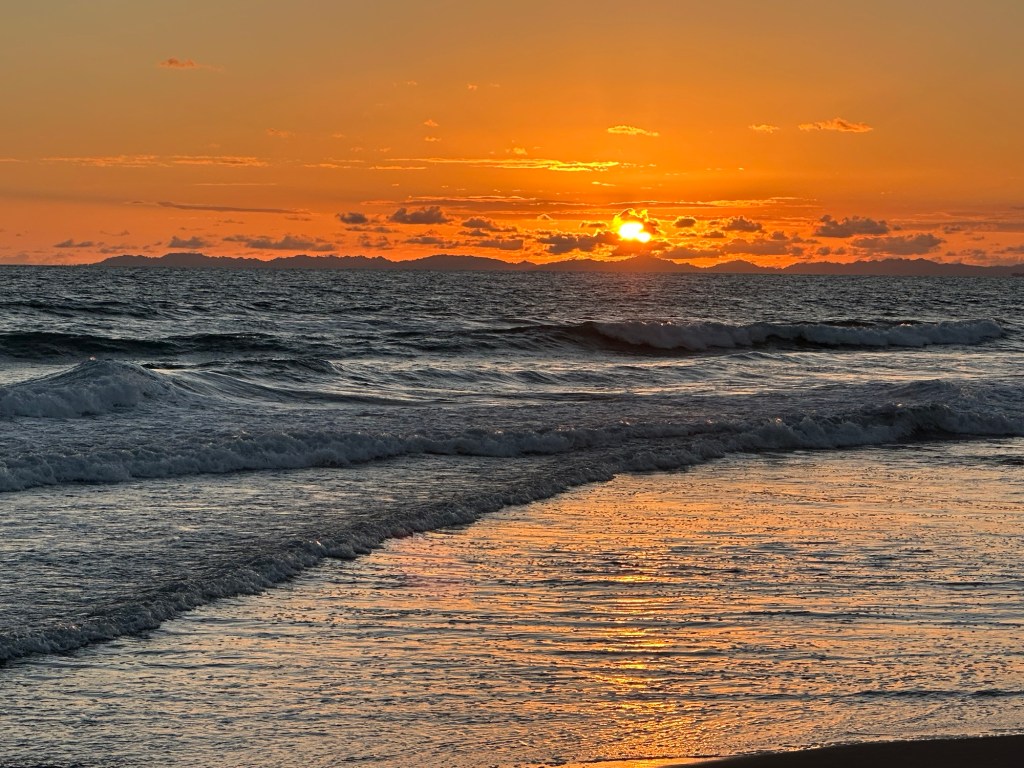
The surfers did their thing and the sun started to set, tinting the slightly heaving sea in gorgeous hues of tangerine. The winners of the competition were announced and people started heading off. I lingered a little longer, soaking up the ambiance of the brilliant sunset before taking my leave.

Sunset, Playa Dominical

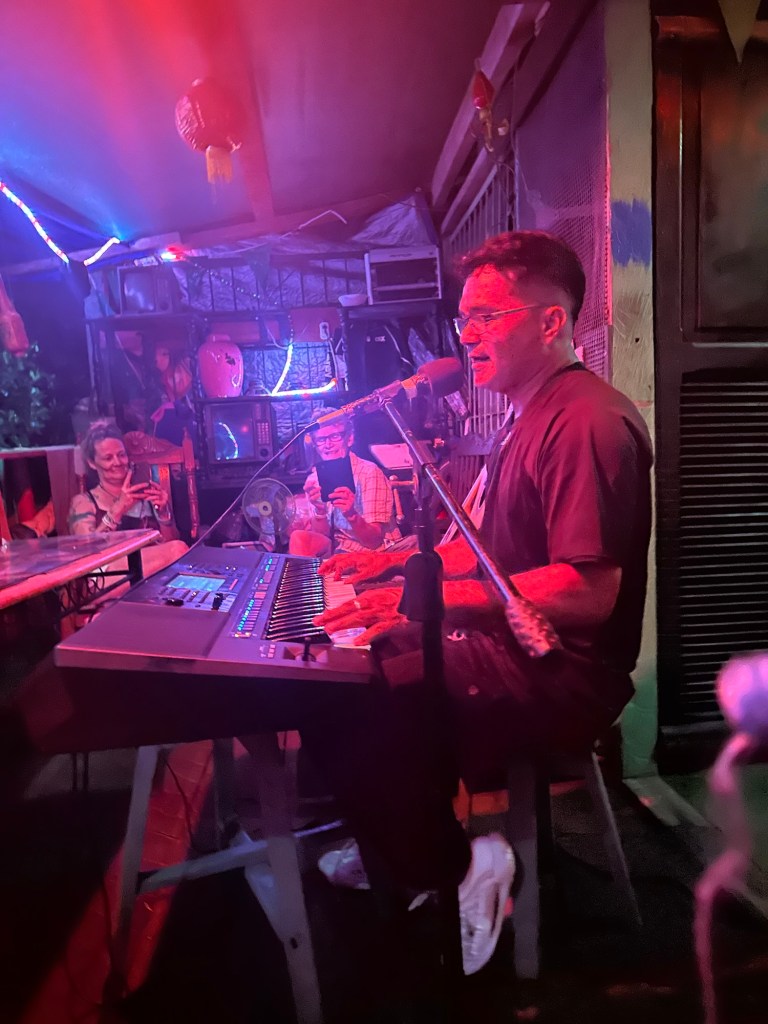
I soon found where many people had retired to – a beachside bar where a local ex-pat band had the evening’s billing. I ordered something to eat and settled down for a great night of awesome music and stage antics.

Montezuma – Jaco

Loitering too long over coffee, pancakes and fruit in my chill little possie in front of the hostel, I ended up having to rush to catch my morning bus out of Montezuma. Panic averted when found a longish line of people waiting to board so patiently waited my turn. This time I was savvy enough to take the sun position into account and sat accordingly on a more comfortable side. Meditatively taking in the picturesque surroundings as it passed me by, I was startled when the bus suddenly braked to allow a large snake to make its way across the road. I asked the driver if it was dangerous and he waved his hand in a nonchalant way I took to mean ‘not so much’. Then it was back down through twisting roads to the ferry terminal in Paquera.

Paquera

I had nearly an hour before the ferry left so plenty of time to purchase my ticket and organise an on-board beer to accompany my sweet deck-side seat. From there it was just a matter of watching tiny, jungle clad islets slowly pass us by as our ferry negotiated the calm, turquoise waters of the Golfo de Nicoya.

Puntarenas

Back at Puntarenas, I tried to find where to catch the bus to Jaco. According to the guidebook, it was on a corner a block away from the terminal. Which corner and in which direction was not provided so I decided to ask around. The first hombre I asked said no, I had to take a taxi into Centro to the bus terminal. The second hombre said nah, just wait on that corner there and it will turn up. I decided to check at the little shop on the corner and that hombre gave me the same information as the first. I bit the bullet and decided I might as well walk the 2.5kms into town and hope for the best.

Churchill truck, Puntarenas

As I had already walked straight through the middle of the little peninsula Puentarenas is situated on, I thought I would walk on the ocean side this time. I passed an ice cream truck selling Puentarenas’ premier dessert – The Churchill and decided to try one. Evidently, it was named after the man who ‘invented’ it who allegedly looked like Winston Churchill. Personally, I think our Churchill lookalike had his in-laws coming over for dinner and chucked whatever he had in the fridge/pantry in a glass bowl. A base of shaved ice, with every conceivable topping and additional dessert option combined, the Churchill was a delicious, albeit bilious, affair.

Puntarenas

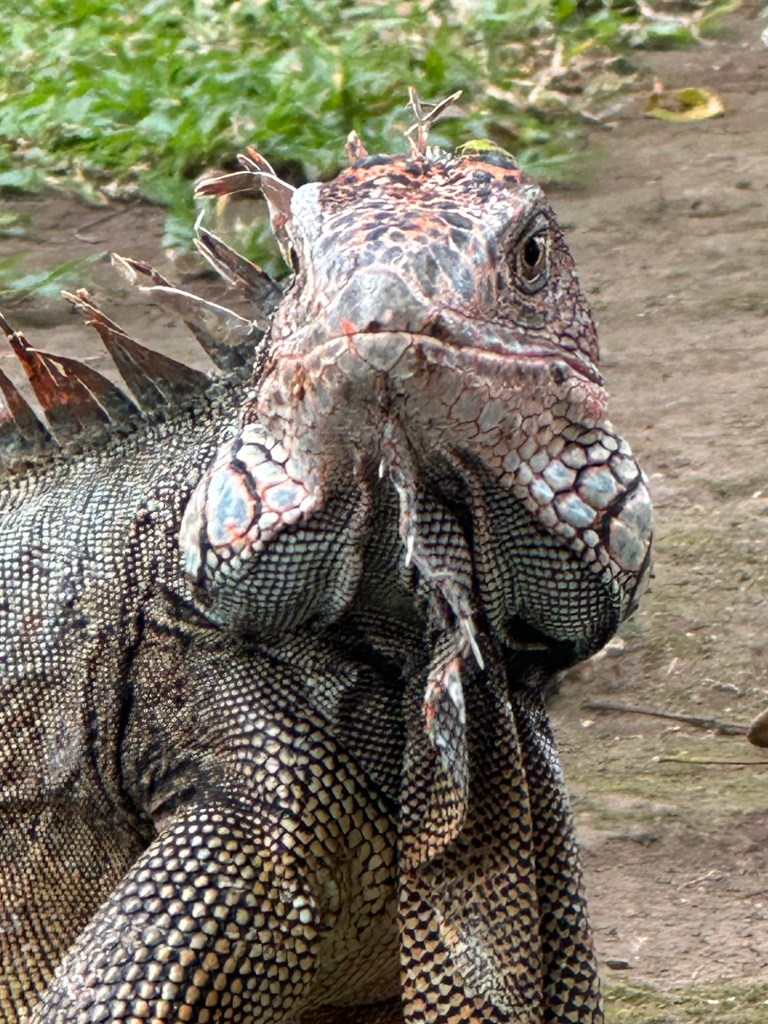
After watching a couple of iguanas having a face off on the median strip while I was consuming my Churchill, I set off in the searing Puentarenas heat. I had directions for the bus terminal and found it easily enough. I had about a half hour’s wait for the next bus heading where I wanted to go, so sat down to cool down a bit while awaiting its arrival.

Casa, Puntarenas

The journey to Jaco headed south inland from the Pacific coast, weaving in and out of small towns and settlements. It was very pleasant sitting in the air cooled bus as it rumbled its way towards its destination. I had no concept of what Jaco was like and even if I had, nothing could have prepared me for the mainstream US coastal tourist town vibe of the place. There was nothing Costa Rican about this place apart from the souvenirs. And it was teeming with tourists. I checked into my hostel and went out in search of a soothing cerveza and something to eat.

Hostel Hacienda Garcia, Jaco

I had decided to do a walk to a lookout the next morning but hated the place so much, I decided to hightail it out of there first opportunity in the morning. So it was back to the hostel after dinner for an early night.

Montezuma

This little hostel provided breakfast so I was up early to partake of coffee beforehand. After a generous serving of pancakes and fresh fruit, I wandered down to the tour office to wait for departure.

Playa Montezuma

We walked down to the beach and piled onto the awaiting boat. Then, we were off zipping along the pristine, palm-clad coastline at a good rate of knots. We stopped midway to see the El Chorro waterfall, one of only seven waterfalls in the world that plunge directly into the sea. As it was dry season, the flow wasn’t immense, but it was still pretty impressive to see from our little boat out at sea.

Cascada El Chorro

We continued on until reaching a jungle clad islet with a little rocky outcrop next door which was sporting an archway. This being a cool tourist stunt of driving the boat through before continuing along further to Isla Tortuga.

Rocky outcrop near Isla Tortuga

Isla Tortuga, contrary to popular opinion, does not derive its name from having anything to do with turtles, other than it is shaped roughly like one. Still, it is a popular tourist destination for snorkeling or just chilling on the beach. I had booked a snorkeling tour, so we were dropped off at a nearby rocky outcrop with strict instructions of where we could and couldn’t go. Unfortunately, the coral here is sporadic and badly bleached, however, the brightly coloured fish provided sufficient entertainment. At the second snorkeling site, I even saw a large spotted ray swimming past.

Playa Isla Tortuga

It was lovely swimming in the cool, turquoise water, but eventually our time was up and we putted over to the island for lunch. Fresh, panfried fish, accompanying by traditional rice and beans and salad, washed down with not so icy beer was just the ticket after a couple of hours in the water. Afterwards, one of the other girls and I decided to be most decadent and ordered Pina Coladas in pineapples to drink in the sea after our lunch. It was nice and cool in the water and hot out so it really was a no-brainer to just stay there until we got the call to get back on board the boat for departure.

Playa Montezuma

A nice, brisk pace back to Montezuma had us back late afternoon when it was time to clean up and change for dinner. I found a little local bar some Canadian ex-pats were drinking at, so joined them and had a great time learning about their time living in Montezuma and the changes they had seen over the years. One of the girls from the snorkeling tour and another girl from her hostel popped in and I ended up going out with them to a lovely restaurant for dinner. After a big day, it was not a late night.
Puntarenas – Montezuma

I had booked my accommodation using my usual method of finding the cheapest on line and hoping for the best. These digs in Puentarenas were certainly cheap – at USD10, it was an absolute bargain! However, that price came at a price. Situated in an old, dilapidated, former market, its three-stories had been converted into as many tiny rooms that could be crammed on each floor. This was supplemented by a couple of dirty, dishevelled showers and toilets. The whole place had an ‘itchy’ feel about it, but apart from the ablution amenities, it was comfortable enough for the night.

Hotel Rio Puentarenas, Puentarenas

I had noted what times the ferry left in the morning so gave myself sufficient time to walk to the terminal. Ticket purchased and I still had time to grab coffee and something to eat before jumping on board and getting a seat on the top deck. This time it was much more crowded, but I managed to get a seat on the side overlooking the Golfo de Nicoya. It was then a very pleasant hour and a half passing the jungle clad rocky islands that dotted the Gulf in the fresh breezes cooled by the water.

Paquera

At Paquera, the ferry docked and I found the bus I needed to take me the rest of the way to Montezuma. Unfortunately, I again didn’t take the direction of travel into account and spent the whole trip in the searing sun. Still the vista was most impressive as I viewed it from under the brim of my hat. After a short stop in Cobano, we finally pulled up in Montezuma; two buses and two ferries, an overnight stay in Puntarenas, and six and a half travel hours from Nicoya later.

Montezuma

Montezuma, while clearly developed for touristic intent still had a chill vibe to it. Smaller and less intense than neighbouring Santa Teresa, I decided to spend my time here rather than moving on. After completing my laundry chores for the week, I went for a wander around this tiny community.

Playa Montezuma

I particularly wanted to do a day snorkeling tour to Isla Tortuga so went in search of the best deal. Tour booked, it was then in search of cost effective Happy Hour cocktails which I eventually found after trawling the entire village. Watching the sun set at my little beachfront restaurant, listening to the waves crash on the sand, was mesmerising. A perfect end to day of travel.

Nicoya – Puntarenas

It was cool and quiet when leaving my lodgings, but it didn’t stay that way for long. Once back in the throng of this busy little town, the heat, humidity and bustle soon caught up. I had to recharge the data on my travel SIM card, so made my way to the Claro office I had passed the previous night en-route to my hotel. I also got directions to the bus terminal from the helpful señora behind the counter.

Hotel Chorotega, Nicoya

The bus station was only a few blocks away and I found it easily. What wasn’t as easy, however, was finding information about routes further south. I could get to Samara which was one of the places I wanted to check out, but there didn’t appear to be any way of getting further south from there. There was also no information of any other destinations south of Nicoya. I decided to chance it and take the bus to Samara and ask when I got there about possible on-going routes.

Parque Central, Nicoya

The journey down to Samara was spectacular, with the road winding through jungle clad hills and over small rivers and streams gently discharging their contents downstream. A fresh breeze cooled the bus when moving, however, it quickly heated back up again when stopping to pick up or drop off passengers en-route. All too soon, we arrived at Samara where I immediately started making enquiries as to how to get further south.

Playa Samara, Samara

Despite my best efforts, there was no other way out of Samara except returning to Nicoya and trying again. I did manage to confirm there was a route down from Nicoya, albeit complicated, so decided to use the hour and a half I had before the bus left again to check out this sweet little coastal village. Samara was completing geared up for tourists, including a little tourist market, but it had a nice, chill vibe. I found a beachside bar and enjoyed an ice-cold cerveza whilst taking in the scenery.

Tourist Market, Samara

Back in Nicoya I had the usual problem of struggling to find information about buses. This country is frustratingly difficult to traverse on public transport as the locals don’t rely on it as much as in other Central American countries, so don’t know about services. A myriad of bus companies ply different routes which adds another layer of complexity to the situation. After asking around a bit, a señor behind a counter at the bus station waved me over and asked where I was going. I explained I wanted to go to either Montezuma or Santa Teresa and he was finally able to give me the information I needed. It turned out I needed to catch a bus to Playa Naranjo, then a ferry to Puentarenas, another ferry to Paquera, then a bus to Montezuma. This was the route a señora had explained to me in Samara so I embraced it with some confidence. The only problem was that the next bus was at 5pm and it was only 2.30pm.

Casa, Nicoya

I wandered around trying to find a restaurant where I could while away the time over something to eat and a cerveza or two, but to no avail. This region is one of only five ‘Blue Zones’ in the world. Whilst its inhabitants may enjoy longer, healthier lifespans than most, it would seem they do it without beer. In the end, after killing another half hour in my holy grail of a quest, I had to settle for a fruit smoothie instead.

Iglesia Colonial de San Blas, Nicoya

I wandered back to the bus terminal at the allotted time and didn’t have to wait long for my bus. I was hoping to be able to see out of the bus for at least half of my two hour ride, but unfortunately, this bus had tinted windows obscuring much of the vista in the gathering dusk. Eventually, I was able to move up behind the driver, so at least could get a better view from the front. It was lovely watching the locals interact with one another and it seemed many were regulars who knew the driver. One thing I am noticing is the Costa Rican catchphrase of ‘Pura Vida’ is not used by the locals unless in the tourism industry. By now, I have travelled nearly all over the country and never heard a local use it once.

Ferry Terminal, Playa Naranja

It was well and truly dark when the bus arrived at the ferry terminal and parked up. I then had to wait another hour for the ferry’s departure, however, was able to board shortly after it arrived from Puentarenas. I found a seat on the top deck to gaze out at the distant lights and take advantage of fresh ocean breezes. An hour later we were in Puentarenas and I made my way to my accommodation for the night. It was late and I was well and truly ready for bed.
Liberia – Nicoya

I was up nice and early to catch my 7am bus. Unfortunately, coffee was a bit late getting started and I didn’t have enough time to grab one beforehand so it was an uncaffeinated start to the day. Still, I made my bus with plenty of time and got a seat right behind the driver for great views of the countryside.

Countryside Liberia

It was a two hour journey which wound its way past Liberia’s International Airport and continued on through primarily farming country. Small pueblos were scattered en route and the bus detoured through their streets to collect and drop off passengers. I didn’t take into account which side the sun would be on when boarding the bus and it burned down on me for most of the trip. I ended up putting my hat on to try eleviate the worst of it.

Playa Tamarindo, Tamarindo

We eventually reached Tamarindo, one of Costa Rico’s tourist hotspots. The only reason I decided to go there was that there was a national park I wanted to check out. I stayed in the bus as it drove through the centre of Tamarindo thinking it would terminate at a bus terminal or at best, a designated stop I could get information about on-going transport. Unfortunately, neither option availed and I ended up at the far end of Tamarindo in luxury condo land where no wild woman should wander. It was only about a kilometre back to the centre though so I trudged through the heat to find an ATM to cash up and a bakery to fuel up.

River Mouth, Rio Tamarindo

Then it was time to find a boat to take me for a tour of the Tamarindo Estuary, part of Parque Nacional Marino Las Baulas. I had got information from a local hombre to walk down to the river mouth and negotiate a tour directly with the boat captain. This I did but found it more than I was hoping to pay. After weighing up whether to cough up the coins or not, I came to the conclusion that I had come here just to see the estuary so might as well. Decision made, I returned to the boat and jumped on board.

Rio Tamarindo

The tide was low, as was the channel the boat had to pass through. It took a while but the skipper and his offsider managed to navigate into deeper water. Once past the sandy river mouth, the estuary was immediately lined with ancient mangrove forest. Interestingly, black mangroves grew on the east side of the estuary and red mangroves grew on the west. A myriad of coastal birds waded, flittered or soared, whilst below in the murky water, fish and crocodiles went about their daily business. On the mud banks, soldier crabs scuttled about.

Mangrove stands, Tamarindo Estuary

After puttering around for a while we stopped to check out a little patch of jungle for howler monkeys. As both the hombres got out of the boat in separate searches for the little beasties, I had to take my pack with me. I wasn’t overly keen on this part of the tour as I had already seen heaps of monkeys and would rather have spent the time on the estuary, but dutifully followed in tow to nil effect. The beasts had bolted and were nowhere in sight. I reassured my guide I wasn’t disappointed and we returned to the boat.

Boat and guide, Tamarindo Estuary

We puttered further on and found a crocodile swimming in the water. Said crocodile was eying off some soldier crabs on the mudbank so was dutifully still for a photo opportunity. We waited for a few minutes to see whether it would lurch out of the water for one of the crabs before eventually moving on. As soon as the boat motor started again, so did our crocodile and quickly disappeared under the swill.

Crocodile eying off soldier crabs, Tamarindo Estuary

Back at the river mouth, I farewelled my guides and walked back to the main road where I could get a bus onwards. I had an hour to wait so stopped for a cerveza next to the bus stop. At the appointed time, the bus lumbered up and I jumped on board. We rolled back up the hill on tightly winding roads and in and out of little pueblos where families were going about their daily life. Eventually we arrived at Santa Cruz where I planned to spend the night.

Fiesta Típicas Nacionales de la Santa Cruz

Santa Cruz had a most festive vibe about it which was confirmed by my bus driver who advised it was the Fiesta Típicas Nacionales de Santa Cruz, one of Costa Rica’s premier events of the year. Taking place deep in ranchero country, this Tican style country and western gathering is an extremely popular week long event drawing a huge crowd. My hopes of attending, however, were dashed by the bus driver stating I would have Buckley’s chance of finding any accommodation and would be best to press on to Nicoya. As I wandered through the throngs of locals, dressed in ranchero garb and dancing to the myriad of local ranchero bands playing on every corner, I was disappointed to have missed such an opportunity. Still, I got a taste of it before finding the bus terminal for Nicoya.

Parqué Central, Nicoya

Nicoya was only half an hour away and I got information about a reasonably priced hotel not too far away from where the bus terminated. Dumping my pack, I went out in such of food. On the other side of the Parque Central, I found a little food truck still open and perched myself down for some local fare. It would seem that some of the party vibes from Santa Cruz extended to Nicoya as the park was brightly and colourfully lit and ranchero music rang throughout. Locals mingled and it provided a pleasant backdrop to my dinner.
Liberia

My last day in Liberia was for going out to Parque Nacional Santa Rosa. Fuelled up with my regulatory coffee, I headed to the bus station. After a pleasant half hour bombing along the highway, I got dropped off at the park entrance. By now, it was searing hot and I was rethinking my decision to walk the 7kms to the area of the park I wanted to visit. I instead chose to get a lift with an Australian guy and his Finnish girlfriend who were driving to where I was heading.

Entrance, Parque Nacional Santa Rosa

This National park visit was for an entirely different purpose. Santa Rosa used to be a sprawling hacienda of cattle ranching and agriculture, before being turned into a national park in 1971 to protect the surrounding tracts of dry tropical forest. This hacienda, however, was not just any old hacienda. The hacienda casona was the site of three important historical battles which shaped the future for Costa Rica. Unfortunately, this overachieving homestead was burned down by arsonists in 2001 but was rebuilt due to its historical significance.

La Casona, Parque Nacional Santa Rosa

These days La Casona houses a museum dedicated to the most important of those three battles; the 1856 Battle of Santa Rosa. The 1850’s saw the rise of filibustering, which is basically trumped up US citizens deciding they would try take over a foreign country by way of military and political interference. The most famous of these was William Walker who had grandiose ideas of taking over Central America. He actually did manage to wheedle his way into power in Nicaragua which he then used as his base to try conquer the rest of the region.

Original stone corrals, Parque Nacional Santa Rosa

Costa Rica picked up on Walker’s dodgy deals and declared war on Nicaragua. The two sides met at the casona in 1856 and after a ‘blink and you miss it’ exchange of 14 mins, Walker’s army were sent limping back to Nicaragua. This was the beginning of the end for Walker as Costa Rica organised the other Central American countries to rise up against his regime and run him out of the region. Walker eventually got his comeuppance when the US government handed him over to the Hondurans for execution. Now he lies beneath Honduran soil for all eternity.

La Casona, Parque Nacional Santa Rosa

At the rear of the casona is a steep hill where a monument to the heroes of all three battles is situated. It is a lovely, peaceful place with views overlooking three of Costa Rica’s impressive volcanos. Sitting there in the shady serenity, it was hard to imagine at three times the casona just metres away was the site of intense battles. Hopefully, those days are now well and truly over as Costa Rica cherishes its peace and freedom from conflict.

Lookout at Monumento a los Héroes, Parque Nacional Santa Rosa

Down past the original stone corrals and cattle dipping station, I found the little Sendero Indio Desnudo. This short trail winds through the forest back to the main road with a natural trail branching off mid-way. I turned off onto this trail and followed it around. I heard the sound of something large moving in the bush and turned just in time to see a white-tailed deer disappearing into its depth. I had actually seen one of these majestic animals from the car on arrival into the park; startling it on a path. Continuing on, I found a small cave which of course I had to check out. It was small and low with hundreds of bats pouring out as I interrupted their slumber. Not wanting to disturb them any further, I backed out and left them in peace.

Small cave, Parque Nacional Santa Rosa

By now it started to cool down and I was happy to walk the 7kms back to the main road to await my bus. There was very little traffic on the road, so ample opportunity to spot all manner of birds and small mammals en-route. I also came across another deer who went crashing into the bush when detecting me.

Animal crossing sign, Parque Nacional Santa Rosa

About half way back to the road was the Mirador Tierras. This beautiful little lookout took in vast vistas of the surrounding countryside; now forested due to fire control, wind and animal seed distribution. It’s the second largest tract of dry, tropical forest in the world; surpassed only by Kakadu National Park in Australia.

Mirador Tierras, Parque Nacional Santa Rosa

It was dusk by the time I reached the highway and totally dark when my bus finally arrived 45 minutes later. Then it was a pleasant 30 minute ride back to Liberia for my last night there.

Liberia

I had booked a 7.15am shuttle up to Parque Nacional Rincón de la Vieja, but was told around 7am there wasn’t a bus running and if I wanted to go, I could take a taxi for USD40. I declined, thinking I would probably catch the bus up and then hitch out to the park. The Señora at the hostel, however, rang one of her friends, and arranged for him to pick me up from the hostel and take me up to Curubande, the closest village to the National park.

Volcán de la Viaja

Offe ran a tourist operation out of Curubande so was going up there as part of his working day. I squeezed in the back of the car with two of his tour guides and we made our way up the mountain. Once there, Offe told me his daughter was coming up to hike with a friend in the National Park and could give me a lift there. So I ended up getting all the way to the park for free, albeit somewhat later than planned.

Entrance, Parque Nacional Rincón de la Vieja

Parque Nacional Rincón de la Vieja has got a curious backstory. According to legend, in Pre-Columbian days, there was a powerful chieftain by the name of Curubande. He ruled his little part of the world and all was peachy. But then his daughter, Princess Curabanda, had the audacity to fall in love with a warrior from a rival tribe. This did not go down well with her Pa who decided to intervene. He tricked Mixcoac, the princess’s beau, into attending a party, got him pissed and threw him into the volcano. Problem solved. However, Princess Curabanda didn’t take it so well and took herself up to the volcano summit to await the arrival of her baby – one can only assume the romance had taken on a more carnal route than anyone realised. Once born, Princess Curabanda ‘reunited’ her son with his father by throwing the infant into the boiling lava. She then spent her remaining days in the nearby jungle, mourning her beloved.

Mini volcanic mud-pots, Parque Nacional Rincón de la Vieja

These days, the crater is off-limits to the public for safety reasons, but one can do a 3.5km loop further down the slope which goes past areas of high volcanic activity. After a short walk from the park entrance through picturesque rainforest, resplendent with spider monkeys and multi-hued birds, the trail spits you out onto a barren plateau covered with active volcanic mud pots and remnant volcanic debris. You follow the trail around to a volcanic lake, more mud-pots and then to a large, extremely active volcanic mud-pot resembling boiling gruel, and a very impressive fumarole.

Volcanic mud-pot, Parque Nacional Rincón de la Vieja

The trail then continues through rainforest to a volcancito (little volcano) and some impressive fumaroles. Steam can then be seen rising through the jungle here and there from the trail until you reach a section of fumaroles and a volcanic steam fed spring. The sheer power of this volcanic energy was evident everywhere, as were the volcano evacuation signs should your visit go pear-shaped.

Volcanic steam fed spring, Parque Nacional Rincón de la Vieja

The trail continued on through rainforest back to the start. I was hoping to hike out to one of the waterfalls, but was disappointed to find they closed those trails at 1pm. As I had planned to spend the day in the park, I decided to walk the 11kms back to Curubande.

Evacuation sign, Parque Nacional Rincón de la Vieja

The road back down to the village was primarily rainforest with some plantation in patches. Fortunately, there wasn’t a lot of traffic so I could just enjoy the ambiance and not have to worry about dodging traffic on the narrow roads. I passed the two geothermal plants which combined with other geothermal plants in the region provide neatly 14% of Costa Rica’s energy needs. There is an ecological debate over this ‘free’ energy in that all the volcanos are in National Parks and National Parks cannot be exploited for commercial gain. It’s an argument that needs careful consideration as Costa Rica moves forward in its efforts to become carbon neutral by 2050.

Parque Nacional Rincón de la Vieja

I was two kms shy of my destination when an SUV pulled up and asked me where I was going. When I told the hombre, he told me he was heading that way and to hop in. I gratefully took up the offer and was able to return to Liberia in air conditioned comfort. Leo dropped me off at what he referred to as ‘American Corner’, an intersection where all the American fast food chains had restaurants. It was close by to my hostel so I only had a short walk back.

Bijagua – Liberia

Breakfast was included in this hostel and since I was the only one there, I was treated like royalty. A large plate of fresh fruit, scrambled eggs and toast, and lashings of good quality coffee all hit the mark. All served on the terrace adjacent an immaculately maintained garden. The señora had put out some fruit scraps which attracted two little squirrels and a multitude of brightly coloured birds. It was a very pleasant way to start the day.

Rio Celeste Backpackers, Bijagua

I got directions to the bus stop and waited for the bus back to Canas. From there, I needed to catch a bus to Liberia, one of the major Costa Rican cities. I could use Liberia as a base to visit another two national parks as it was cheaper and easier than going somewhere else closer to both. The Liberian bound bus wound its way through the suburban streets for a while, before hitting the Pan-American Highway and then bombing along before reaching Liberia.

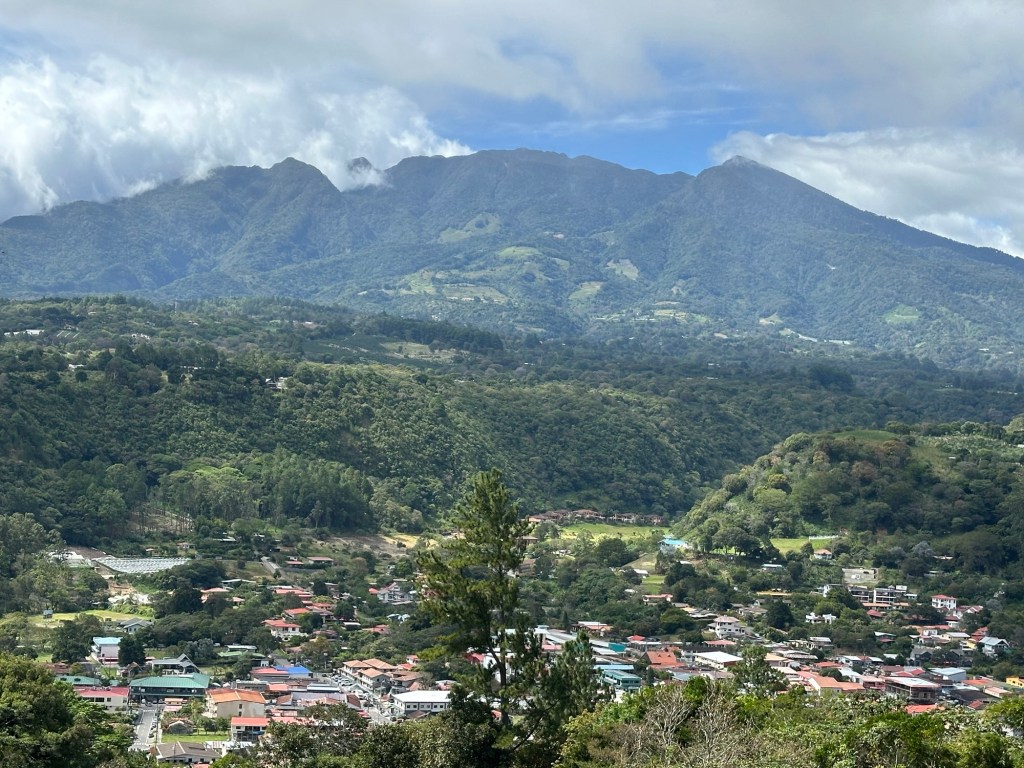
View to the mountains, Bijagua

I found a hostel and checked in. Then I had a very important question to ask. Midway through these trips I need to find a half-way decent hairdresser to touch up my roots. I used to dread the potential outcome but am much more chill about it now. I mean, the worst that could happen is my hair all falls out… The señora gave me directions to a hairdresser at the local market, however, I think she missed the brief of a ‘good hairdresser’. I punched hairdressers into Google Maps and found a nearby salon with a good rating. I showed her this and she confirmed it was a ‘very good salon’. Thus satisfied, I headed out.

Hostel Pura Vida, Liberia

Sirius Salon and Spa was just what I expected – a small salon trying to impersonate a quality hair salon. everything was shabby and the small quantity of product was behind lock and key. My stylist, Leo, was lovely though and after explaining what I wanted, left it in his hands and waited to see what transpired. What did transpire was a quality job with a price tag to match. I paid about what I would back home, but at least I could tick that job off until I got home again.

Liberia Streetscape

By the time I had finished, the day nearly was as well so I sought out cerveza and something to eat. A fairly chill afternoon in downtown Liberia but I had plans for a much more active day tomorrow.