
I had found out what time the bus left in the morning when I arrived in Tilaran the night before so I wasn’t spending a whole day there waiting. After grabbing a take away coffee and something to eat from a nearby bakery, I headed back to the bus terminal. I had to catch a bus to Cañas and then another one to Bijagua which was the closest town to the National Park I wanted to visit. This time I was finally on top of how to use the Costa Rican public transport system with any degree of certainty by checking timetables and asking staff at each stop. By now I had completely discarded any of the recommended on-line platforms as being either too inaccurate and/or unreliable.
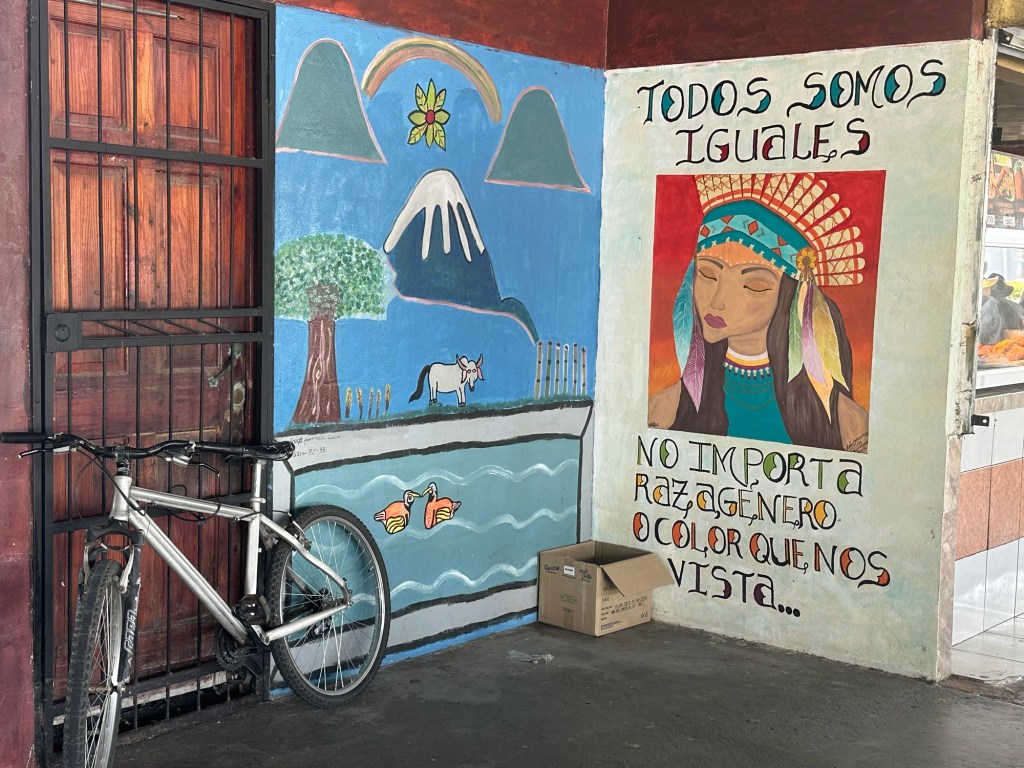
The journey to Canas went through pretty countryside and tiny villages. All the while with the volcanic range looming in the distance. I kept an eye open for the hostel I had booked into but couldn’t see any signs. I got dropped off in the centre of town and walked back to where Google Maps said it should be. Nothing. After walking back and forth, a señora from a casa waved me over just as I was heading over to ask her if she knew where the hostel was. It turned out they were doing some renovating so took the sign down. I would have thought it prudent to at least replace it with a temporary one, but at least I had found my digs for the night. I dumped my pack and organised transport up to Parque Nacional Volcán Tenorio.
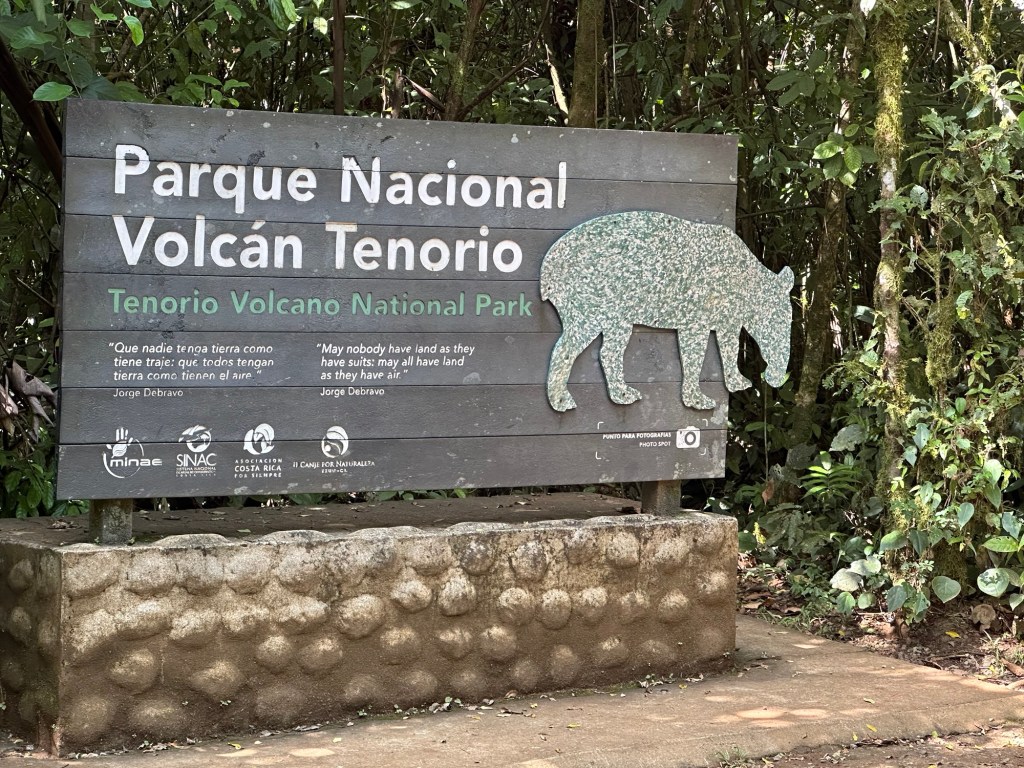
Parque Nacional Volcón Tenorio is a 189 square km reserve with Volcán Tenorio the big guy of the park. You can’t climb the volcano as it’s too dangerous, but you can see the beautiful Rio Celeste which winds it’s way around it. And of course, that magnificent rainforest the area is known for. There is a 5km hiking trail which takes in some of the best bits which of course I was keen to tackle.

I was expecting the park to be overrun with tourists but the first section to the waterfall actually wasn’t that bad. There were tour groups but it wasn’t as crowded as what I had experienced in other parks at times. The walk to the waterfall was on a well maintained hard track and a fairly comfortable meander. When you got to the entrance to the waterfall though, it became a whole other story. Steep steps and many of them led down into the valley below. But the effort was totally worth it when you clapped eyes on the Catarata de Rio Celeste – a 30m torrent of pure white crashing into an aquamarine pool below.

It was fortunate there was lots to admire and take photos of as lots of stops were required on the slog of a hike back up the valley. This was the point that the tour groups (and most people) turned back so I had opportunity for a more tranquil hike checking out more of the park’s charms. The trail leading off the main path was natural so more challenging in sections with one needing to scramble over tree roots and boulders in places. It followed the Rio Celeste upstream past beautiful blue lagoons including one which had volcanic activity in a corner; the water burbling away from the thermal gases below.
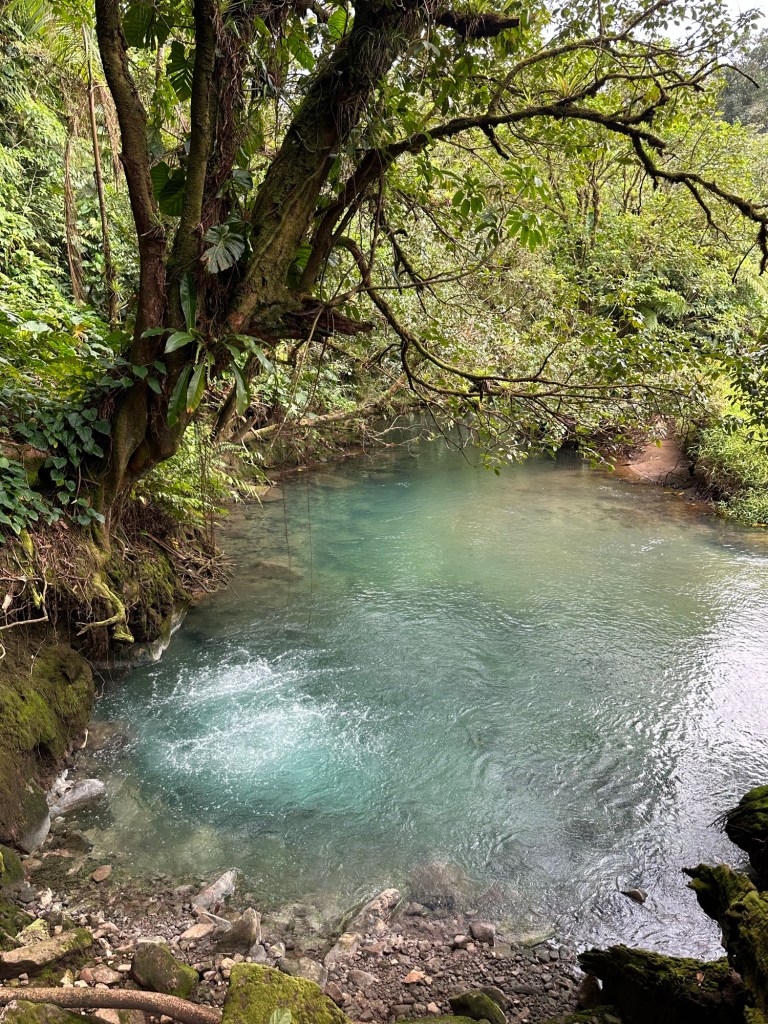
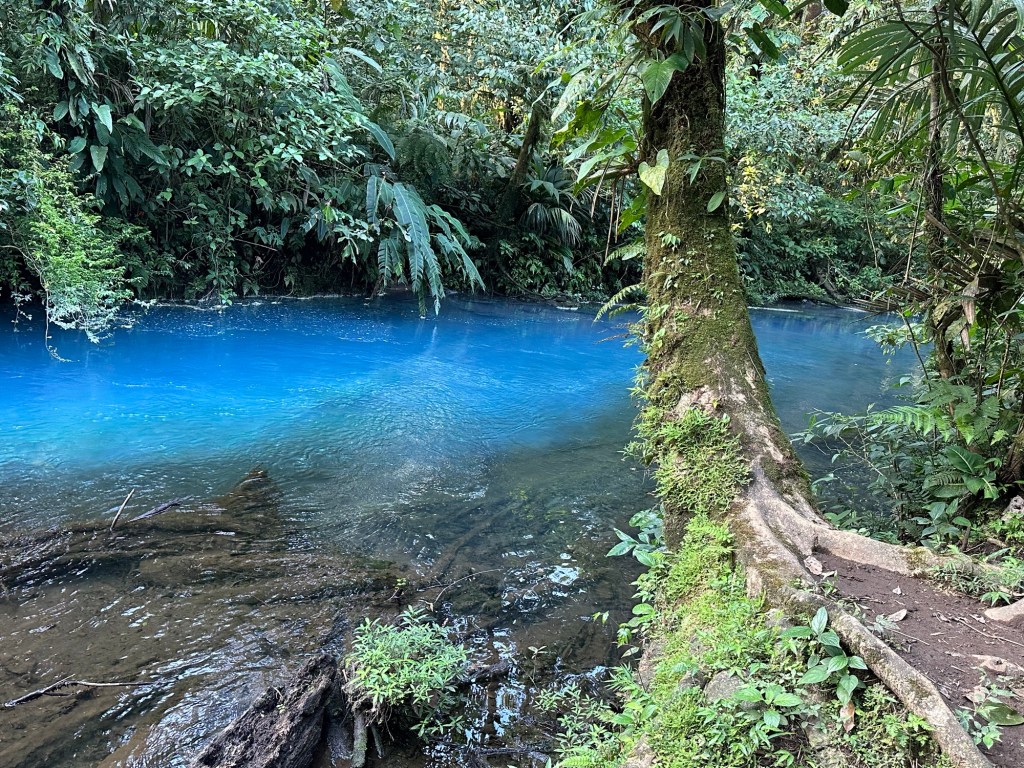
The vivid blue of the water is actually an optical illusion caused by the convergence of two rivers containing different minerals and ph levels. The result is a scattering of sunlight off suspended particles in the river which our eyes (and camera lens) register as bright blue. It truly is a surreal image. The blue is deeper the closer you get to the source and gradually fades along a 14km section of the river.

I was now close to the source and the blue was so intense as to seem unworldly. Fringed by lush, tropical rainforest it was certainly a sight to behold. I continued on along a muddy track, crossing two small bridge, following this mysterious river all the time. At the end of the trail was the point called El Teñidoro – The Dyer. This was where the Rio Buena Vista and Quebrada Agria converge to form the Rio Celeste. It really does look like someone has poured dye into the river and the ‘mixing’ effect is most surreal.
By this stage of the day it was starting to get late and I wasn’t surprised to see a park ranger ambling up to the trail end. There were three South American girls recording sounds for a podcast as well as myself and I thought the ranger was rounding us up to vacate the park. It turned out not the fact and Cecilia, the Park Ranger, ended up giving us a private tour and some entertaining stories as she accompanied us back towards the entrance. She showed us a tiny, but deadly, viper curled up sleeping on a palm leaf just off the track. These incredible creatures are so well camouflaged it is difficult to spot them. We also saw toucans and many other birds along the way.

It was nearly dark when we got back to the park entrance and the previously bustling carpark and surrounding restaurants and stalls were ghostly quiet. I had caught a taxi up to the park as I didn’t have a lot of time to get there before they stopped people entering in the early afternoon. I was considering hitchhiking back but was out much later than expected. Cecilia was going to call a taxi for me but the South American girls offered to take me into Bijagua even though they were going in the opposite direction. I chatted with them on the way back down the mountain and found out two of them produce a soundscape podcast. They were lovely girls and had very interesting stories. I got them to drop me off in town as I was planning on finding somewhere to have a meal before returning to my hostel. This time at least I knew where that was.
 Wild Woman Wandering